Connect a QuickBooks company file, send it a request and read the answer, all from the dashboard. Then make the same request from your code.
Connect to QuickBooks or a simulator
Use a simulated connection if you don’t have QuickBooks handy. It’s ready in seconds, and your code won’t
change when you connect real QuickBooks later.
Simulated QuickBooks
Your own QuickBooks Desktop
About 3 minutes, nothing to install. QuBe Sync hosts a sample company file that answers like
QuickBooks Desktop.
1
Create your account
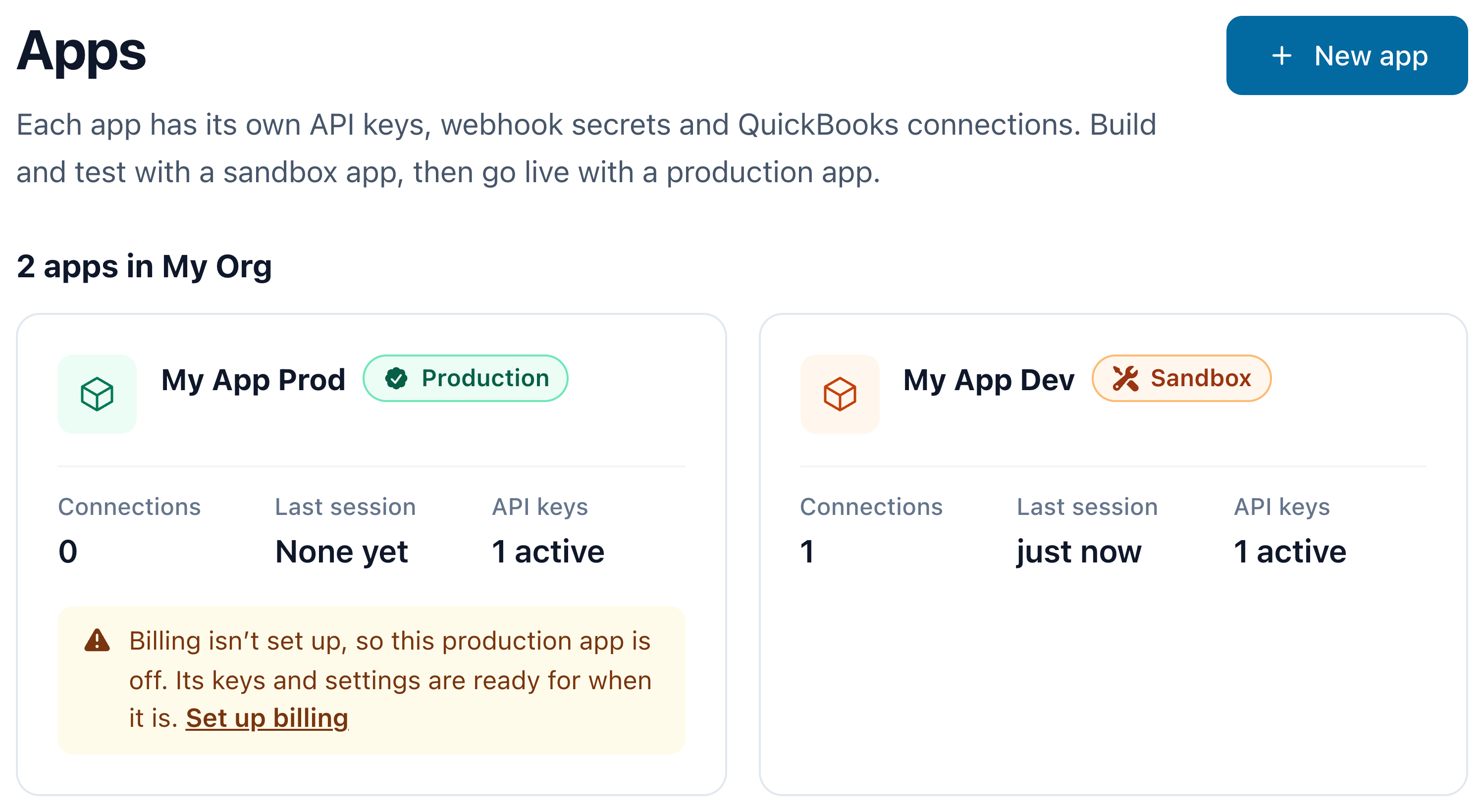
Sign up and confirm your email. Your account is preloaded with a sandbox app to build in.
Every new organization starts with a sandbox app and a production app.
2
Add a simulated connection
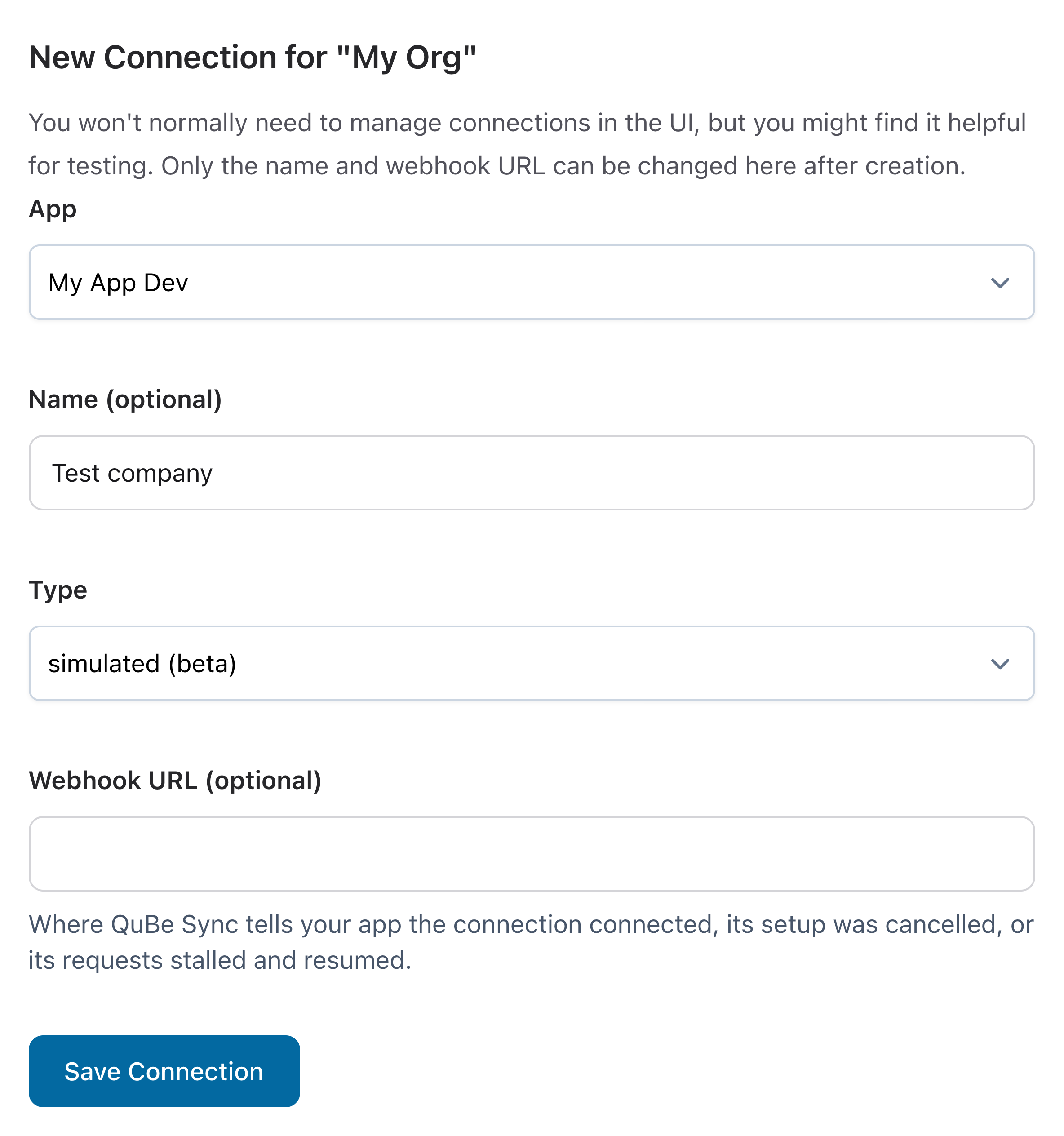
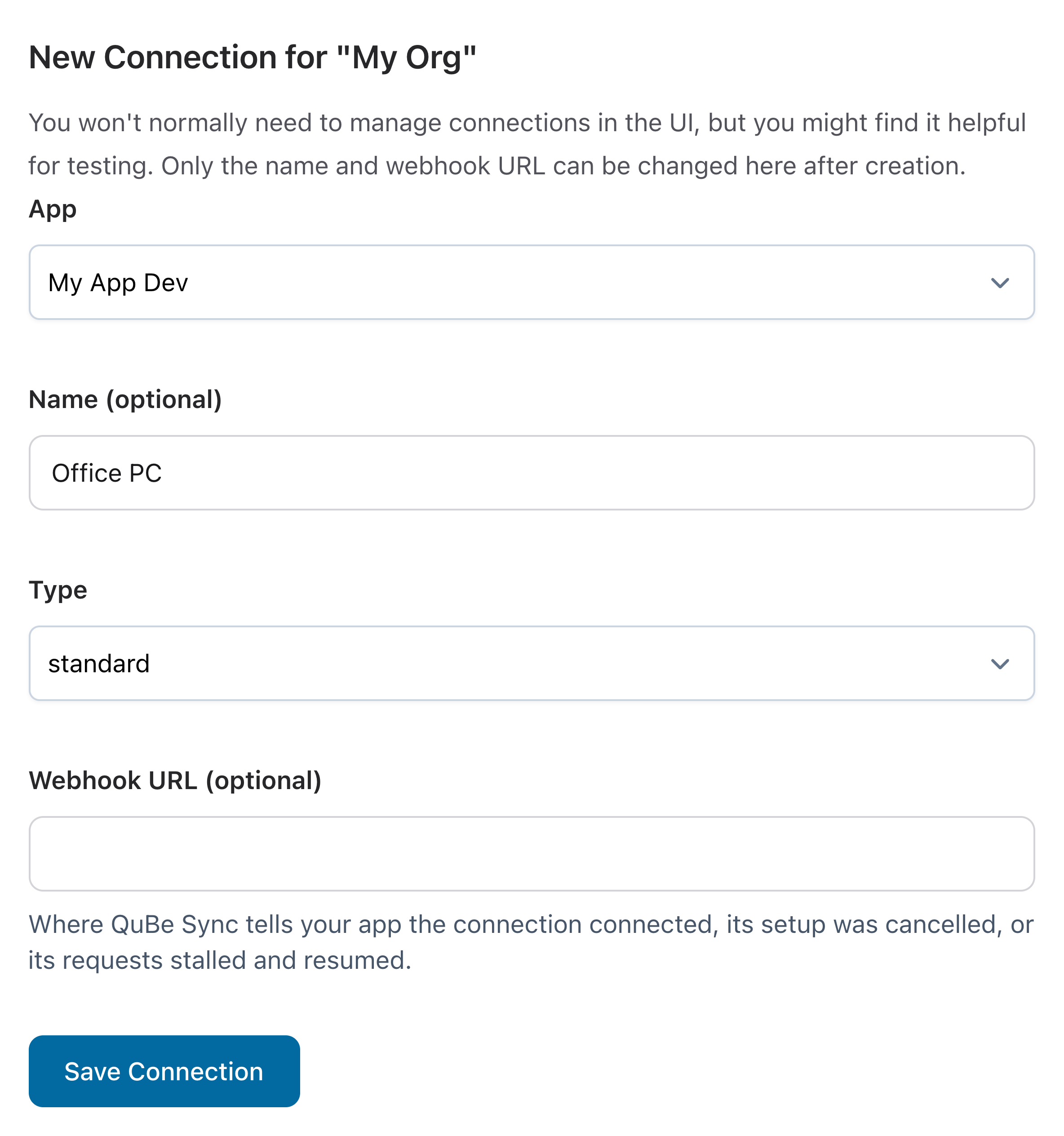
Open QB Connections -> New Connection
The name is optional.
It’s immediately “connected” to a sample company with customers, items and transactions. The simulator is in beta, so test against real QuickBooks before you launch.
qube loginqube use "My App Dev"qube env --writeqube connections create --simulated --name "Test company"
3
Send a test request
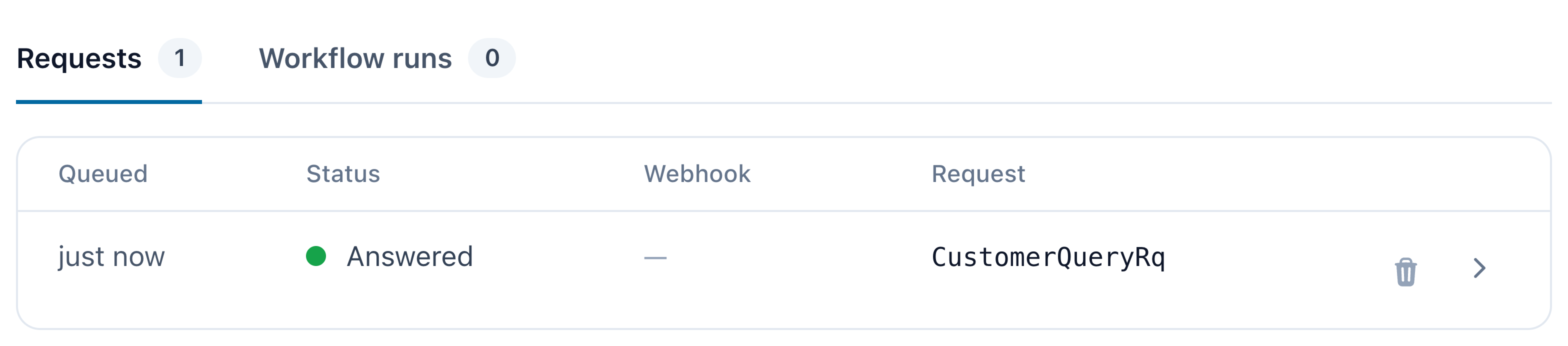
On the connection’s page, click Queue test request. It asks QuickBooks for the first 10
customers, and the simulator answers within seconds.
The request goes from Waiting to Answered on its own.
4
Read the answer
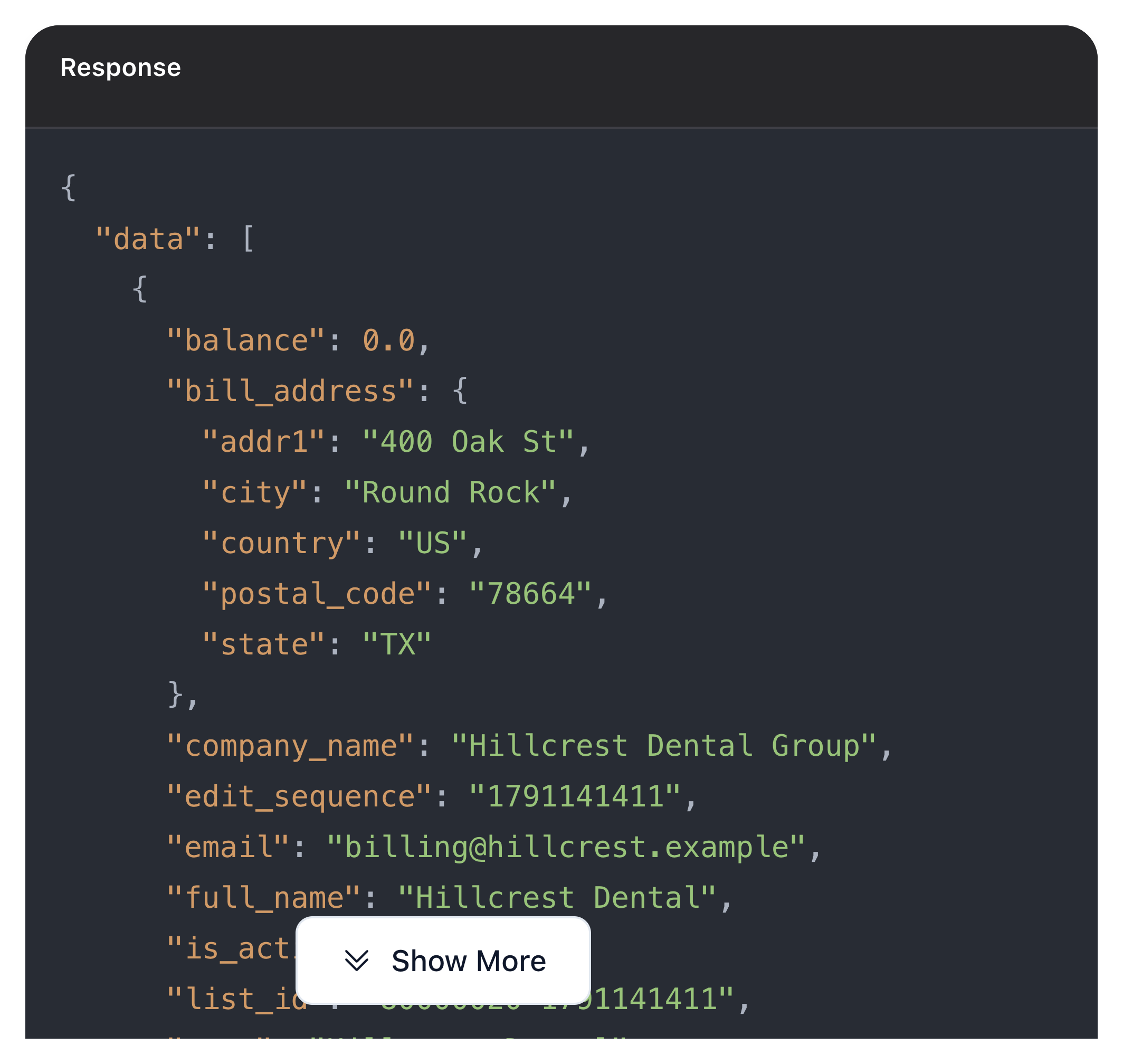
Click the request. Response JSON shows QuickBooks’ answer, the sample company’s customers, in
the same shape your app will receive it.
Each request keeps its qbXML, its JSON and its webhook attempts.
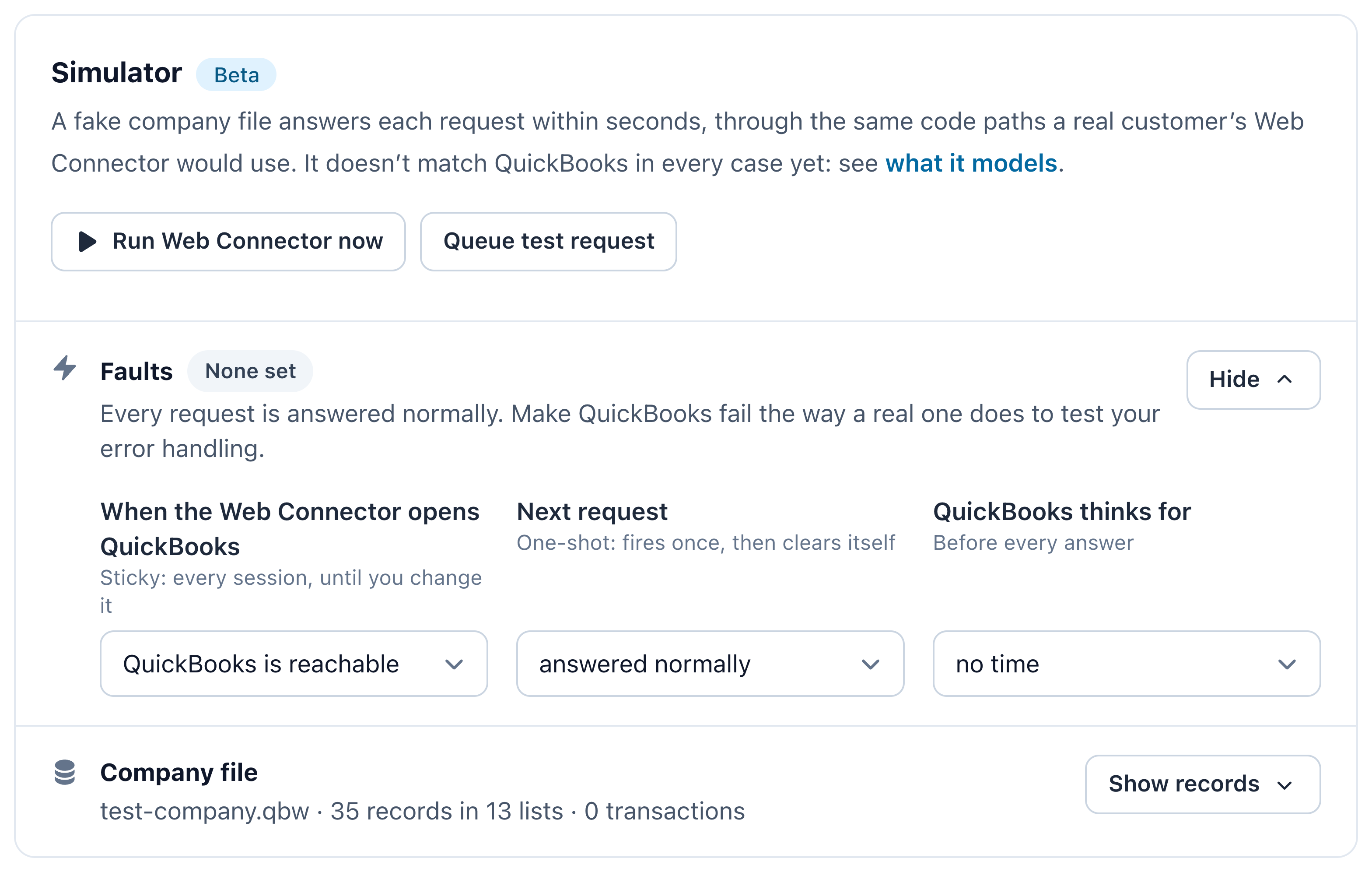
Make the next request fail on purpose
Real integrations fail in ways that are hard to reproduce, like a name that’s already taken. On
the connection’s page, click Set faults beside Faults, set Next request to answered with
3100: name already in use, then click Queue test request again. Its state is error, with the same
refusal QuickBooks would send.
About 6 minutes. You need a Windows computer or VM with QuickBooks Desktop (Pro, Premier or
Enterprise) and a company file to test with. No copy? Get a free not-for-resale
license and open one of QuickBooks’ sample companies.
1
Create your account
Sign up and confirm your email. Your account is preloaded with a sandbox app to build in.
Every new organization starts with a sandbox app and a production app.
2
Add a connection
Open QB Connections -> New Connection
Name it after the company file, so you can tell your connections apart.
3
Connect QuickBooks
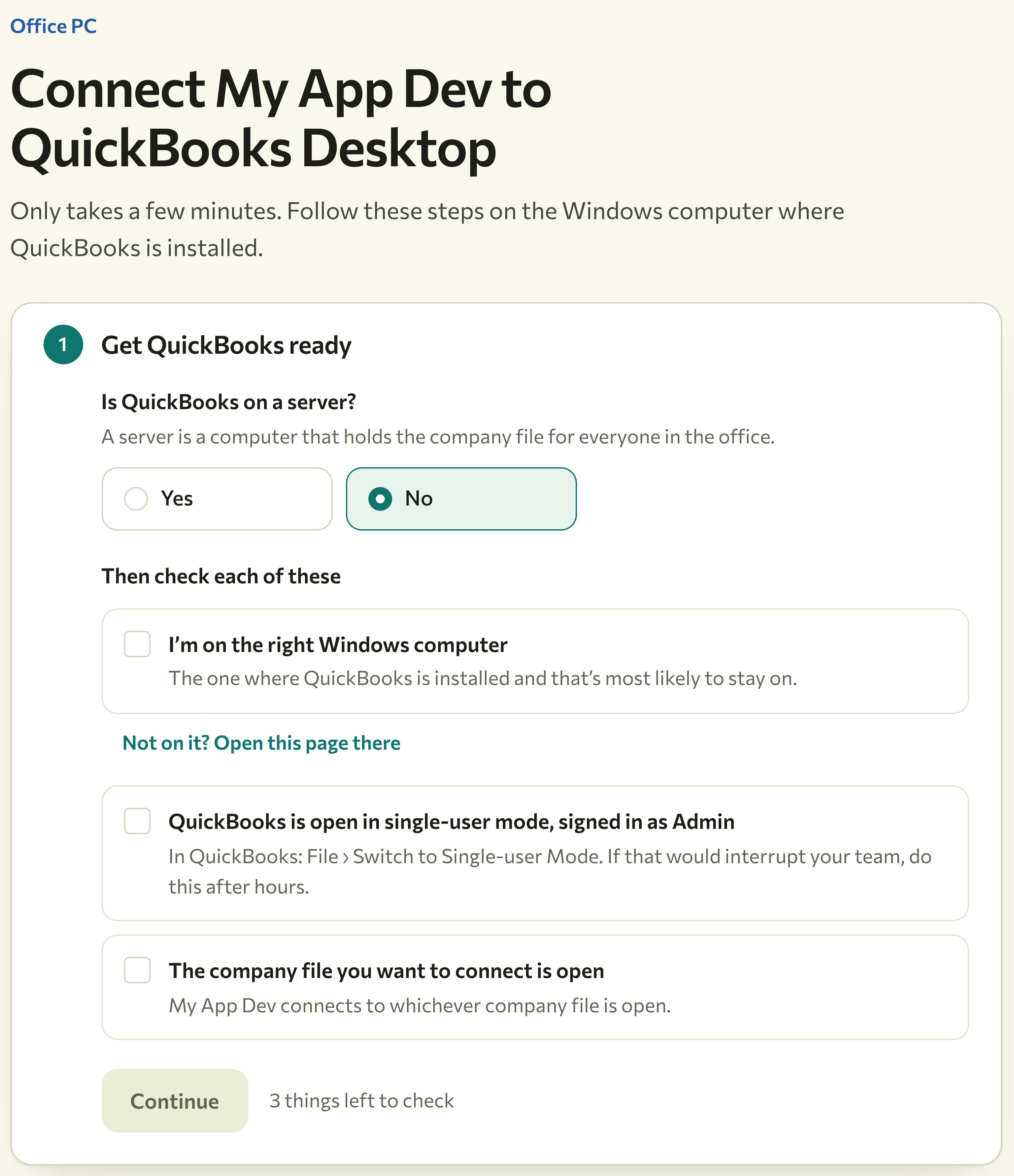
On the connection’s page, click Copy onboarding link and open it on the computer that runs
QuickBooks. It’s the page your customers will use: a short checklist, then a .qwc file to open in
the Web Connector and a password to paste into it.
Your customers see the same page, with your app's name.
When the Web Connector finishes its first update, the connection’s page stops waiting for it: its
status changes from Never connected, and its header says Last session with the time it checked
in.
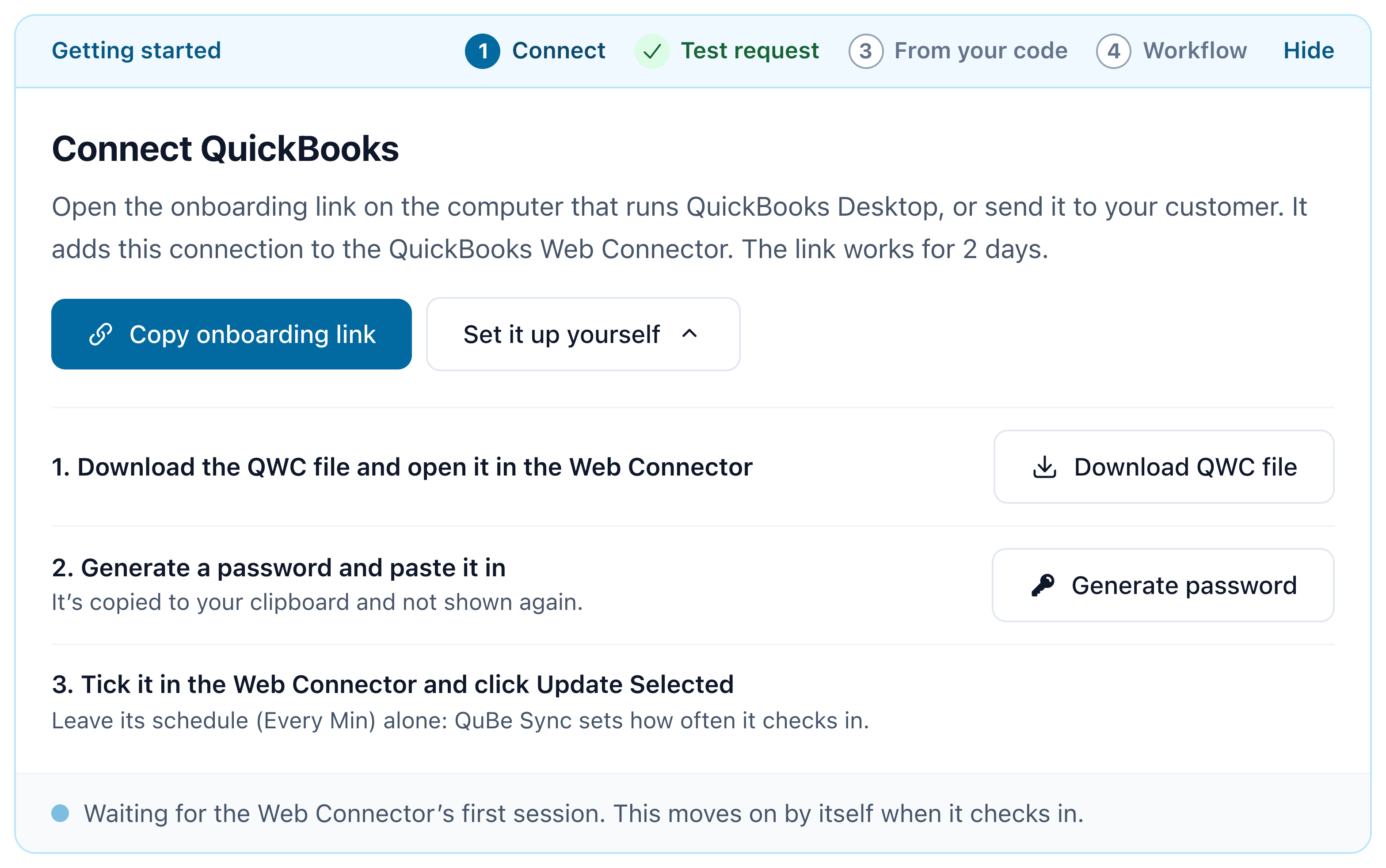
Set it up without the onboarding page
On the connection’s page, click Set it up yourself under Copy onboarding link if its steps
are folded. (Once it has connected, they’re under Web Connector setup → Show.)
Click Download QWC file and open the file on the QuickBooks computer. When QuickBooks
asks, choose Yes, always; allow access even if QuickBooks is not running.
Click Generate password. It’s copied to your clipboard: paste it into the Web
Connector’s Password column.
Tick the app in the Web Connector and click Update Selected.
The Web Connector shows an error
Its log says why, usually in the last few lines. Read the Web Connector logs for
where to find it and what the common errors mean. If adding the file is refused with QBWC1039
“Unique OwnerID/FileID pair value required”, the company file already holds this connection’s
setup: Common problems
says how to clear it.
4
Send a test request
On the connection’s page, click Queue test request. It asks QuickBooks for the first 10
customers. QuickBooks answers the next time the Web Connector runs: within 5 minutes, or straight
away if you click Update Selected in the Web Connector.
The request waits until the Web Connector checks in, then shows Answered.
5
Read the answer
Click the request. Response JSON shows QuickBooks’ answer, your company file’s customers, in
the same shape your app will receive it.
Each request keeps its qbXML, its JSON and its webhook attempts.
Do it from your code
Queue test request is a shortcut for one API call. To make it yourself, copy two values from the
dashboard:
Where to find your API key
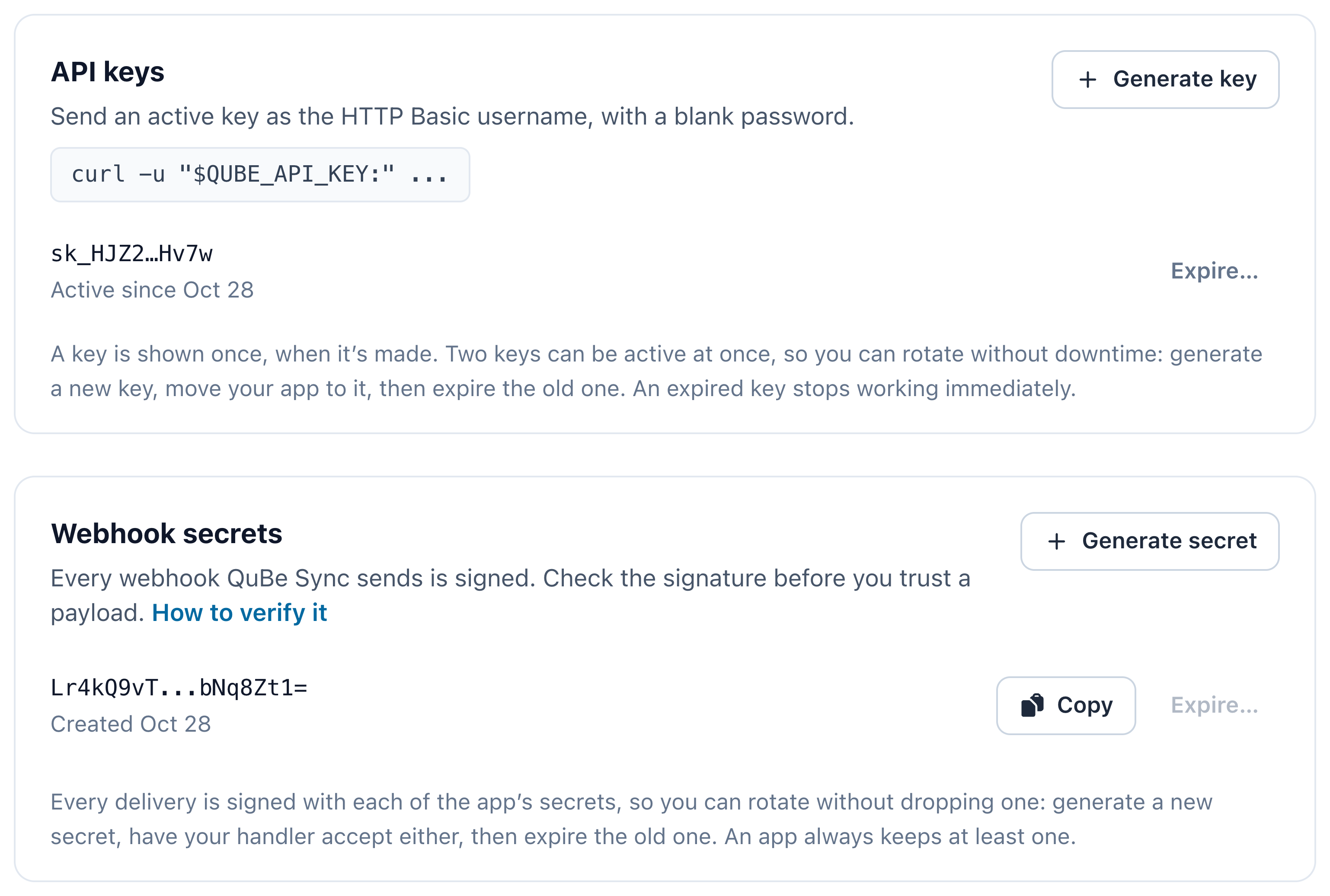
Open My Applications, then My App Dev. QuBe Sync shows a key only once, when it’s made, so an
owner of your organization either clicks Download .env, which makes a new key for the file (and
replaces the key in their last download), or clicks Generate key and copies it then. After that
the page shows only the key’s first and last characters. qube env --write makes one for you too.
Each app has its own keys. Keep them out of your code and your logs.
Where to find your connection ID
Go to QB Connections -> your new connection; copy Connection ID at the top of the connection’s page.
qube loginqube use "My App Dev"qube qb customers list "$CONN_ID" --max-returned 2 --wait # prints QuickBooks' answer
Where to next
Connect your customers
Send each customer to the hosted onboarding page from a button in your app.
Receive answers in your app
Pass a webhook_url with each request, and QuBe Sync POSTs QuickBooks’ answer to it the moment it
arrives. No polling. On your laptop, qube listen forwards them to your local app.
Make requests
Create invoices, update customers and query anything in QuickBooks.
Test without QuickBooks
What the sample company holds, and every failure the simulator can fake.
How it works
Apps, connections, requests and the Web Connector, and how they fit together.
{"docsConfig":{"theme":"mint","$schema":"https://mintlify.com/docs.json","name":"QuBe Sync","colors":{"primary":"#16A34A","light":"#07C983","dark":"#15803D"},"logo":{"light":"https://mintcdn.com/qubesync/gN_APnIajnQKnywV/logo/full-light.png?fit=max\u0026auto=format\u0026n=gN_APnIajnQKnywV\u0026q=85\u0026s=0690db6248367802891c15bad08ae9e9","dark":"https://mintcdn.com/qubesync/gN_APnIajnQKnywV/logo/full-dark.png?fit=max\u0026auto=format\u0026n=gN_APnIajnQKnywV\u0026q=85\u0026s=49fb7c4ae5cb86868e1d029c62580428"},"favicon":{"light":"https://mintcdn.com/qubesync/gN_APnIajnQKnywV/favicon.ico?fit=max\u0026auto=format\u0026n=gN_APnIajnQKnywV\u0026q=85\u0026s=ecfae754138bc13cdcb4d589ad584c71","dark":"https://mintcdn.com/qubesync/gN_APnIajnQKnywV/favicon.ico?fit=max\u0026auto=format\u0026n=gN_APnIajnQKnywV\u0026q=85\u0026s=ecfae754138bc13cdcb4d589ad584c71"},"navbar":{"links":[{"href":"mailto:[email protected]","label":"Support"}],"primary":{"type":"button","label":"Dashboard","href":"https://qubesync.com/app"}},"footer":{"socials":{"github":"https://github.com/qubeintegrations","linkedin":"https://linkedin.com/company/qube-integrations"}},"contextual":{"options":["copy","view","chatgpt","claude"],"display":"header"},"styling":{"latex":false},"navigation":{"global":{"anchors":[{"anchor":"QuBe Sync Slack","icon":"slack","href":"https://qubeintegrations.slack.com"}]},"pages":[]}},"deployment":{"deploymentMetadataValue":{"subdomain":"qubesync","hasAudioNarration":false,"actualSubdomain":"qubesync","customDomains":["docs.qubesync.com"],"gitSource":{"type":"github","owner":"qubeintegrations","repo":"docs","deployBranch":"main","contentDirectory":"","isPrivate":false,"mountPath":"","label":""},"entitlements":{},"buildId":"6af92252f1de041cd0132f0a","clientVersion":"0.0.4143","searchFilterCounts":[{"language":"default","tag":"API Reference","count":332},{"language":"default","tag":"API v2","count":308},{"language":"default","tag":"Workflows","count":30},{"language":"default","tag":"API v1 (legacy)","count":23},{"language":"default","tag":"Guides","count":19},{"language":"default","tag":"Connections","count":19},{"language":"default","tag":"Pre-built Queries","count":12},{"language":"default","tag":"Queued Requests","count":9},{"language":"default","tag":"Build your integration","count":6},{"language":"default","tag":"Data Ext Defs","count":4}]},"assistantConfig":{},"basePath":"","hasChatPermissions":false,"hasWebMcpPermissions":false,"toggles":[{"name":"kill-isr","enabled":true,"variant":{"name":"disabled","enabled":false,"feature_enabled":true},"impressionData":false},{"name":"custom-rbac-roles","enabled":true,"variant":{"name":"disabled","enabled":false,"feature_enabled":true},"impressionData":false},{"name":"agent-mintlify-slack","enabled":true,"variant":{"name":"disabled","enabled":false,"feature_enabled":true},"impressionData":false},{"name":"agent-integrations-settings","enabled":true,"variant":{"name":"disabled","enabled":false,"feature_enabled":true},"impressionData":false},{"name":"rbac-expansion","enabled":true,"variant":{"name":"disabled","enabled":false,"feature_enabled":true},"impressionData":false},{"name":"automations-pr-grouping","enabled":true,"variant":{"name":"disabled","enabled":false,"feature_enabled":true},"impressionData":false},{"name":"custom-prefix","enabled":true,"variant":{"name":"disabled","enabled":false,"feature_enabled":true},"impressionData":false},{"name":"analytics-v7","enabled":true,"variant":{"name":"disabled","enabled":false,"feature_enabled":true},"impressionData":false},{"name":"user-flows-analytics","enabled":true,"variant":{"name":"disabled","enabled":false,"feature_enabled":true},"impressionData":false},{"name":"no-publish-flow","enabled":true,"variant":{"name":"disabled","enabled":false,"feature_enabled":true},"impressionData":false},{"name":"workos-onboarding","enabled":true,"variant":{"name":"disabled","enabled":false,"feature_enabled":true},"impressionData":false},{"name":"snapshot-serving-live","enabled":true,"variant":{"name":"disabled","enabled":false,"feature_enabled":true},"impressionData":false},{"name":"stripTemperatureMiddleware","enabled":true,"variant":{"name":"disabled","enabled":false,"feature_enabled":true},"impressionData":false},{"name":"support-platform-pylon-zendesk","enabled":true,"variant":{"name":"disabled","enabled":false,"feature_enabled":true},"impressionData":false},{"name":"snapshot-serving","enabled":true,"variant":{"name":"disabled","enabled":false,"feature_enabled":true},"impressionData":false},{"name":"instant-rollback","enabled":true,"variant":{"name":"disabled","enabled":false,"feature_enabled":true},"impressionData":false},{"name":"granular-notifications-server","enabled":true,"variant":{"name":"disabled","enabled":false,"feature_enabled":true},"impressionData":false},{"name":"granular-notifications","enabled":true,"variant":{"name":"disabled","enabled":false,"feature_enabled":true},"impressionData":false},{"name":"automations-fable","enabled":true,"variant":{"name":"disabled","enabled":false,"feature_enabled":true},"impressionData":false},{"name":"fixed-ai-action-pricing","enabled":true,"variant":{"name":"disabled","enabled":false,"feature_enabled":true},"impressionData":false},{"name":"automation-resolve-merge-conflict","enabled":true,"variant":{"name":"disabled","enabled":false,"feature_enabled":true},"impressionData":false},{"name":"scoped-publishing","enabled":true,"variant":{"name":"disabled","enabled":false,"feature_enabled":true},"impressionData":false},{"name":"mintql","enabled":true,"variant":{"name":"disabled","enabled":false,"feature_enabled":true},"impressionData":false},{"name":"page-level-analytics","enabled":true,"variant":{"name":"disabled","enabled":false,"feature_enabled":true},"impressionData":false},{"name":"editor-version-history-v2","enabled":true,"variant":{"name":"disabled","enabled":false,"feature_enabled":true},"impressionData":false},{"name":"billing-page-v2","enabled":true,"variant":{"name":"disabled","enabled":false,"feature_enabled":true},"impressionData":false},{"name":"full-page-search","enabled":true,"variant":{"name":"disabled","enabled":false,"feature_enabled":true},"impressionData":false},{"name":"workspace-projects","enabled":true,"variant":{"name":"disabled","enabled":false,"feature_enabled":true},"impressionData":false},{"name":"assistant-v5","enabled":true,"variant":{"name":"disabled","enabled":false,"feature_enabled":true},"impressionData":false},{"name":"fork-pr-previews","enabled":true,"variant":{"name":"disabled","enabled":false,"feature_enabled":true},"impressionData":false},{"name":"revalidation-jwt","enabled":true,"variant":{"name":"disabled","enabled":false,"feature_enabled":true},"impressionData":false},{"name":"workos-sso-scim","enabled":true,"variant":{"name":"disabled","enabled":false,"feature_enabled":true},"impressionData":false},{"name":"hobby-abuse-scan","enabled":true,"variant":{"name":"disabled","enabled":false,"feature_enabled":true},"impressionData":false},{"name":"dashboard-inbox","enabled":true,"variant":{"name":"disabled","enabled":false,"feature_enabled":true},"impressionData":false},{"name":"workos-signup","enabled":true,"variant":{"name":"disabled","enabled":false,"feature_enabled":true},"impressionData":false},{"name":"turbopuffer-dual-write","enabled":true,"variant":{"name":"disabled","enabled":false,"feature_enabled":true},"impressionData":false},{"name":"workos-enabled","enabled":true,"variant":{"name":"disabled","enabled":false,"feature_enabled":true},"impressionData":false},{"name":"approve-review-flow","enabled":true,"variant":{"name":"disabled","enabled":false,"feature_enabled":true},"impressionData":false},{"name":"editor-metadata","enabled":true,"variant":{"name":"disabled","enabled":false,"feature_enabled":true},"impressionData":false},{"name":"sso-setup-deadline-banner","enabled":true,"variant":{"name":"disabled","enabled":false,"feature_enabled":true},"impressionData":false},{"name":"turbopuffer-serve","enabled":true,"variant":{"name":"disabled","enabled":false,"feature_enabled":true},"impressionData":false},{"name":"live-agents","enabled":true,"variant":{"name":"disabled","enabled":false,"feature_enabled":true},"impressionData":false},{"name":"llms-txt-v2","enabled":true,"variant":{"name":"disabled","enabled":false,"feature_enabled":true},"impressionData":false}],"googleFontsInlined":false},"customCss":[{"filePath":"style.css","content":"[data-badge=\"true\"]{white-space:nowrap}[data-badge=\"true\"] code{background:none;border:0;border-radius:0;padding:0}.qube-request{--qr-frame: rgb(243 247 245);--qr-border: rgb(10 15 12 / 0.1);--qr-panel: #fff;--qr-title: rgb(63 67 64);--qr-button: rgb(112 116 114);--qr-button-hover: rgb(63 67 64);--qr-hover: rgb(229 231 235 / 0.5);--qr-focus: rgb(var(--primary));--qr-ink: #1f2328;--qr-method: #0550ae;--qr-muted: #6e7781;--qr-param: #8250df;--qr-key: #116329;--qr-string: #0a3069;--qr-number: #0550ae;--qr-literal: #0550ae;--qr-mono: paperMono, ui-monospace, SFMono-Regular, Menlo, Monaco, Consolas, \"Liberation Mono\", \"Courier New\", monospace;min-width:0;max-width:100%;margin:1.25rem 0 2rem;padding:2px;border:1px solid var(--qr-border);border-radius:1rem;background:var(--qr-frame)}.dark .qube-request{--qr-frame: rgb(255 255 255 / 0.05);--qr-border: rgb(255 255 255 / 0.1);--qr-panel: rgb(11 12 14);--qr-title: rgb(206 211 208);--qr-button: rgb(159 163 160);--qr-button-hover: rgb(206 211 208);--qr-hover: rgb(55 65 81 / 0.7);--qr-focus: rgb(var(--primary-light));--qr-ink: #d4d4d4;--qr-method: #569cd6;--qr-muted: #808080;--qr-param: #c586c0;--qr-key: #9cdcfe;--qr-string: #ce9178;--qr-number: #b5cea8;--qr-literal: #569cd6}.qube-request-head{display:flex;align-items:center;gap:0.5rem;padding:0.25rem 0.625rem 0.25rem 1rem;font-size:0.75rem;font-weight:500;line-height:1.5rem}.qube-request-title{flex:1;min-width:0;overflow:hidden;text-overflow:ellipsis;white-space:nowrap;color:var(--qr-title)}.qube-request-copy{display:inline-flex;flex:none;align-items:center;gap:0.375rem;height:1.625rem;padding:0 0.375rem;border:0;border-radius:0.5rem;background:transparent;font:inherit;color:var(--qr-button);cursor:pointer}.qube-request-copy:hover{background:var(--qr-hover);color:var(--qr-button-hover)}.qube-request-copy:focus-visible{outline:1px solid var(--qr-focus);outline-offset:0}.qube-request-code{margin:0;padding:0.875rem 1rem;overflow-x:auto;border-radius:14px;background:var(--qr-panel);font-family:var(--qr-mono);font-size:0.875rem;line-height:1.5rem;color:var(--qr-ink)}.qube-request-code code{display:block;padding:0;background:none;font:inherit;color:inherit;white-space:pre}.qube-request-method{font-weight:600;color:var(--qr-method)}.qube-request-prefix{color:var(--qr-muted)}.qube-request-param{color:var(--qr-param)}.qube-request-key{color:var(--qr-key)}.qube-request-string{color:var(--qr-string)}.qube-request-number{color:var(--qr-number)}.qube-request-literal{color:var(--qr-literal)}.qube-points{margin:0.5rem 0 1.5rem}.qube-point{display:flex;gap:1rem;padding:1.125rem 0;border-bottom:1px solid rgb(10 15 12 / 0.1)}.qube-point:last-child{border-bottom:0}.dark .qube-point{border-color:rgb(255 255 255 / 0.1)}.qube-point>svg{flex:none;margin-top:0.25rem}.qube-point>div{min-width:0}.qube-point [data-as=\"p\"]{display:block;margin:0}.qube-point [data-as=\"p\"]+[data-as=\"p\"]{margin-top:0.125rem}"}],"page":{"pagePath":"quickstart","slug":"/quickstart","pageMetadata":{"title":"Quickstart","description":"Connect a QuickBooks company file, send it a request and read the answer, all from the dashboard. Then make the same request from your code.","icon":"rocket","href":"/quickstart"},"description":{"compiledSource":"\"use strict\";\nconst {jsx: _jsx} = arguments[0];\nconst {useMDXComponents: _provideComponents} = arguments[0];\nfunction _createMdxContent(props) {\n const _components = {\n p: \"p\",\n ..._provideComponents(),\n ...props.components\n };\n return _jsx(_components.p, {\n children: \"Connect a QuickBooks company file, send it a request and read the answer, all from the dashboard. Then make the same request from your code.\"\n });\n}\nfunction MDXContent(props = {}) {\n const {wrapper: MDXLayout} = {\n ..._provideComponents(),\n ...props.components\n };\n return MDXLayout ? _jsx(MDXLayout, {\n ...props,\n children: _jsx(_createMdxContent, {\n ...props\n })\n }) : _createMdxContent(props);\n}\nreturn {\n default: MDXContent\n};\n","frontmatter":{},"scope":{}},"pageType":"default","mdx":{"mdxSource":{"compiledSource":"\"use strict\";const{Fragment:_Fragment,jsx:_jsx,jsxs:_jsxs}=arguments[0];const{useMDXComponents:_provideComponents}=arguments[0];const Request=({method=`GET`,path,query,body,file,label,auth=true})=>{const[copied,setCopied]=useState(false);const WIDTH=80;const BASE=`https://qubesync.com`;const inline=v=>{if(Array.isArray(v))return`[`+v.map(inline).join(`, `)+`]`;if(v!==null\u0026\u0026typeof v===`object`){return`{`+Object.entries(v).map(([k,x])=>JSON.stringify(k)+`: `+inline(x)).join(`, `)+`}`}return JSON.stringify(v)};const fmt=(v,col,lead,force)=>{const flat=inline(v);if(!force\u0026\u0026lead+flat.length+1\u003c=WIDTH)return flat;const pad=` `.repeat(col+2);if(Array.isArray(v)\u0026\u0026v.length){const rows=v.map((x,i)=>pad+fmt(x,col+2,pad.length)+(i\u003cv.length-1?`,`:``));return[`[`,...rows,` `.repeat(col)+`]`].join(`\n`)}if(v!==null\u0026\u0026typeof v===`object`\u0026\u0026Object.keys(v).length){const entries=Object.entries(v);const rows=entries.map(([k,x],i)=>{const key=pad+JSON.stringify(k)+`: `;return key+fmt(x,col+2,key.length)+(i\u003centries.length-1?`,`:``)});return[`{`,...rows,` `.repeat(col)+`}`].join(`\n`)}return flat};const formatJson=(v,col,lead)=>fmt(v,col,lead,!(v!==null\u0026\u0026typeof v===`object`\u0026\u0026!Array.isArray(v)\u0026\u0026Object.keys(v).length===1));const dedent=text=>{const[first,...rest]=text.split(`\n`);const indents=rest.filter(l=>l.trim()).map(l=>l.match(/^ */)[0].length);const cut=indents.length?Math.min(...indents):0;return[first,...rest.map(l=>l.slice(Math.min(cut,l.match(/^ */)[0].length)))].join(`\n`)};const requestParts=({method=`GET`,path,query,body,file,auth=true})=>{const params=Object.entries(query||{});const queryString=params.map(([k,v])=>k+`=`+v).join(`\u0026`);const hasBody=body!==undefined\u0026\u0026body!==null;const shown=!hasBody?``:typeof body===`string`?dedent(body):formatJson(body,0,0);const env=name=>`$`+(name===`connection_id`?`CONN_ID`:name.toUpperCase());const url=BASE+path.replace(/\\{(\\w+)\\}/g,(_,name)=>env(name));const getWithParams=method===`GET`\u0026\u0026params.length>1;const lines=auth?[`-u \"$QUBE_API_KEY:\"`]:[];if(getWithParams)lines.push(`-G`);if(method!==`GET`)lines.push(`-X `+method);lines.push(`\"`+(params.length\u0026\u0026!getWithParams?url+`?`+queryString:url)+`\"`);if(getWithParams)params.forEach(([k,v])=>lines.push(`--data-urlencode \"`+k+`=`+v+`\"`));if(hasBody){lines.push(`-H \"Content-Type: application/json\"`);const text=typeof body===`string`?dedent(body):formatJson(body,2,2+4);lines.push(file?`-d @`+file:`-d '`+text+`'`)}const curl=`curl `+lines.join(` \\\\\n `);const http=method+` `+path+(queryString?`?`+queryString:``)+(hasBody?`\n\n`+shown:``);return{params,queryString,hasBody,shown,curl,http}};const{params,hasBody,shown,curl}=requestParts({method,path,query,body,file,auth});const title=label||`Request`;const copy=()=>{const text=curl;const done=()=>{setCopied(true);setTimeout(()=>setCopied(false),2e3)};if(navigator.clipboard\u0026\u0026navigator.clipboard.writeText){navigator.clipboard.writeText(text).then(done,()=>{});return}const area=document.createElement(`textarea`);area.value=text;document.body.appendChild(area);area.select();document.execCommand(`copy`);document.body.removeChild(area);done()};const prefix=path.startsWith(`/api/v2`)?`/api/v2`:``;const pathParts=path.slice(prefix.length).split(/(\\{\\w+\\})/).map((part,i)=>/^\\{\\w+\\}$/.test(part)?_jsx(`span`,{className:`qube-request-param`,children:part},i):part);const valueClass=v=>typeof v===`number`?`qube-request-number`:typeof v===`boolean`?`qube-request-literal`:`qube-request-string`;const json=text=>{const out=[];const re=/(\"(?:\\\\.|[^\"\\\\])*\")(\\s*:)?|\\b(true|false|null)\\b|(-?\\d+(?:\\.\\d+)?)|(\\{\\.\\.\\.\\})/g;let last=0;let m;while(m=re.exec(text)){if(m.index>last)out.push(text.slice(last,m.index));const cls=m[1]?m[2]?`qube-request-key`:`qube-request-string`:m[3]?`qube-request-literal`:m[4]?`qube-request-number`:`qube-request-literal`;out.push(_jsx(`span`,{className:cls,children:m[1]?m[1]:m[0]},m.index));if(m[2])out.push(m[2]);last=m.index+m[0].length}if(last\u003ctext.length)out.push(text.slice(last));return out};const queryParts=params.length?[`?`,...params.flatMap(([k,v],i)=>[i?`\u0026`:``,_jsx(`span`,{className:`qube-request-key`,children:k},k+`-key`),`=`,_jsx(`span`,{className:valueClass(v),children:String(v)},k+`-value`)])]:null;return _jsxs(`div`,{className:`qube-request not-prose`,children:[_jsxs(`div`,{className:`qube-request-head`,children:[_jsx(`span`,{className:`qube-request-title`,title,children:title}),_jsxs(`button`,{type:`button`,className:`qube-request-copy`,onClick:copy,\"aria-live\":`polite`,children:[_jsx(`svg`,{width:`16`,height:`16`,viewBox:`0 0 18 18`,fill:`none`,stroke:`currentColor`,strokeWidth:`1.5`,strokeLinecap:`round`,strokeLinejoin:`round`,\"aria-hidden\":`true`,children:copied?_jsx(`polyline`,{points:`4 9.5 7.5 13 14 5`}):_jsxs(`g`,{children:[_jsx(`rect`,{x:`6.5`,y:`6.5`,width:`9`,height:`9`,rx:`2`}),_jsx(`path`,{d:`M3.5 11.5v-6a2 2 0 0 1 2-2h6`})]})}),copied?`Copied`:`Copy as curl`]})]}),_jsx(`pre`,{className:`qube-request-code`,children:_jsxs(`code`,{children:[_jsx(`span`,{className:`qube-request-method`,children:method}),` `,prefix?_jsx(`span`,{className:`qube-request-prefix`,children:prefix}):null,pathParts,queryParts,hasBody?[`\n\n`,...json(shown)]:null]})})]})};function _createMdxContent(props){const _components={a:`a`,code:`code`,em:`em`,li:`li`,ol:`ol`,p:`p`,pre:`pre`,span:`span`,strong:`strong`,..._provideComponents(),...props.components},{Accordion,AccordionGroup,Badge,Card,CardGroup,CodeBlock,CodeGroup,Frame,Heading,Info,OptimizedImage,Step,Steps,Tab,Tabs,Tip,Visibility,_MdxComponentBoundary}=_components;if(!Accordion)_missingMdxReference(`Accordion`,true);if(!AccordionGroup)_missingMdxReference(`AccordionGroup`,true);if(!Badge)_missingMdxReference(`Badge`,true);if(!Card)_missingMdxReference(`Card`,true);if(!CardGroup)_missingMdxReference(`CardGroup`,true);if(!CodeBlock)_missingMdxReference(`CodeBlock`,true);if(!CodeGroup)_missingMdxReference(`CodeGroup`,true);if(!Frame)_missingMdxReference(`Frame`,true);if(!Heading)_missingMdxReference(`Heading`,true);if(!Info)_missingMdxReference(`Info`,true);if(!OptimizedImage)_missingMdxReference(`OptimizedImage`,true);if(!Step)_missingMdxReference(`Step`,true);if(!Steps)_missingMdxReference(`Steps`,true);if(!Tab)_missingMdxReference(`Tab`,true);if(!Tabs)_missingMdxReference(`Tabs`,true);if(!Tip)_missingMdxReference(`Tip`,true);if(!Visibility)_missingMdxReference(`Visibility`,true);if(!_MdxComponentBoundary)_missingMdxReference(`_MdxComponentBoundary`,true);return _jsxs(_Fragment,{children:[_jsx(Heading,{level:`2`,id:`connect-to-quickbooks-or-a-simulator`,children:`Connect to QuickBooks or a simulator`}),`\n`,_jsxs(_components.p,{children:[`Use a `,_jsx(_components.strong,{children:`simulated`}),` connection if you don’t have QuickBooks handy. It’s ready in seconds, and your code won’t\nchange when you connect real QuickBooks later.`]}),`\n`,_jsxs(Tabs,{children:[_jsxs(Tab,{title:`Simulated QuickBooks`,icon:`flask`,id:`simulated-quickbooks`,children:[_jsx(Tip,{children:_jsxs(_components.p,{children:[_jsx(_components.strong,{children:`About 3 minutes, nothing to install.`}),` QuBe Sync hosts a sample company file that answers like\nQuickBooks Desktop.`]})}),_jsxs(Steps,{children:[_jsxs(Step,{title:`Create your account`,children:[_jsxs(_components.p,{children:[_jsx(_components.a,{href:`https://qubesync.com/users/register`,children:`Sign up`}),` and confirm your email. Your account is preloaded with a sandbox app to build in.`]}),_jsx(Frame,{caption:`Every new organization starts with a sandbox app and a production app.`,children:_jsx(OptimizedImage,{src:`https://mintcdn.com/qubesync/0vBf1cM4bTpV_SLq/images/quickstart/apps.png?fit=max\u0026auto=format\u0026n=0vBf1cM4bTpV_SLq\u0026q=85\u0026s=58243d6ac7fc53fb068e83ada3450d8a`,alt:`My Applications, listing My App Dev with a SANDBOX badge and My App Prod with a Set up billing to enable badge`,\"data-og-width\":`2996`,width:`2996`,\"data-og-height\":`1640`,height:`1640`,\"data-path\":`images/quickstart/apps.png`,\"data-optimize\":`true`,\"data-opv\":`3`,srcset:`https://mintcdn.com/qubesync/0vBf1cM4bTpV_SLq/images/quickstart/apps.png?w=280\u0026fit=max\u0026auto=format\u0026n=0vBf1cM4bTpV_SLq\u0026q=85\u0026s=932d5e8f85fac7182e377615e559591b 280w, https://mintcdn.com/qubesync/0vBf1cM4bTpV_SLq/images/quickstart/apps.png?w=560\u0026fit=max\u0026auto=format\u0026n=0vBf1cM4bTpV_SLq\u0026q=85\u0026s=8c87d3ff79ef45b5f11923eda66b8db0 560w, https://mintcdn.com/qubesync/0vBf1cM4bTpV_SLq/images/quickstart/apps.png?w=840\u0026fit=max\u0026auto=format\u0026n=0vBf1cM4bTpV_SLq\u0026q=85\u0026s=a95f97e7c44448ddba38f5fa81697b74 840w, https://mintcdn.com/qubesync/0vBf1cM4bTpV_SLq/images/quickstart/apps.png?w=1100\u0026fit=max\u0026auto=format\u0026n=0vBf1cM4bTpV_SLq\u0026q=85\u0026s=2b8351ee9d338a5867331ccd9af22879 1100w, https://mintcdn.com/qubesync/0vBf1cM4bTpV_SLq/images/quickstart/apps.png?w=1650\u0026fit=max\u0026auto=format\u0026n=0vBf1cM4bTpV_SLq\u0026q=85\u0026s=e4aa50682c67f0f78d1cd82dbf05d692 1650w, https://mintcdn.com/qubesync/0vBf1cM4bTpV_SLq/images/quickstart/apps.png?w=2500\u0026fit=max\u0026auto=format\u0026n=0vBf1cM4bTpV_SLq\u0026q=85\u0026s=1b506b02f983b51bd0f98a15323c3682 2500w`})})]}),_jsxs(Step,{title:`Add a simulated connection`,children:[_jsx(_components.p,{children:`Open QB Connections -> New Connection`}),_jsx(Frame,{caption:`The name is optional.`,children:_jsx(OptimizedImage,{src:`https://mintcdn.com/qubesync/0vBf1cM4bTpV_SLq/images/quickstart/new-connection-simulated.png?fit=max\u0026auto=format\u0026n=0vBf1cM4bTpV_SLq\u0026q=85\u0026s=f0b1dd4f9394b44a407095ee7090a4a7`,alt:`The New Connection form with App set to My App Dev, Name set to Test company and Type set to simulated (beta)`,style:{maxWidth:`592px`},\"data-og-width\":`2368`,width:`2368`,\"data-og-height\":`2528`,height:`2528`,\"data-path\":`images/quickstart/new-connection-simulated.png`,\"data-optimize\":`true`,\"data-opv\":`3`,srcset:`https://mintcdn.com/qubesync/0vBf1cM4bTpV_SLq/images/quickstart/new-connection-simulated.png?w=280\u0026fit=max\u0026auto=format\u0026n=0vBf1cM4bTpV_SLq\u0026q=85\u0026s=e320ab91449addea956acfb238624363 280w, https://mintcdn.com/qubesync/0vBf1cM4bTpV_SLq/images/quickstart/new-connection-simulated.png?w=560\u0026fit=max\u0026auto=format\u0026n=0vBf1cM4bTpV_SLq\u0026q=85\u0026s=46373e69e282bb4677e59c2929bbf6cd 560w, https://mintcdn.com/qubesync/0vBf1cM4bTpV_SLq/images/quickstart/new-connection-simulated.png?w=840\u0026fit=max\u0026auto=format\u0026n=0vBf1cM4bTpV_SLq\u0026q=85\u0026s=b6ce5cb3af86743ca74a5eb46a26adab 840w, https://mintcdn.com/qubesync/0vBf1cM4bTpV_SLq/images/quickstart/new-connection-simulated.png?w=1100\u0026fit=max\u0026auto=format\u0026n=0vBf1cM4bTpV_SLq\u0026q=85\u0026s=7bd6406d0ffcc1107ac76322c5157f2c 1100w, https://mintcdn.com/qubesync/0vBf1cM4bTpV_SLq/images/quickstart/new-connection-simulated.png?w=1650\u0026fit=max\u0026auto=format\u0026n=0vBf1cM4bTpV_SLq\u0026q=85\u0026s=eb5f8ff2630b8731e640e37f37b459c7 1650w, https://mintcdn.com/qubesync/0vBf1cM4bTpV_SLq/images/quickstart/new-connection-simulated.png?w=2500\u0026fit=max\u0026auto=format\u0026n=0vBf1cM4bTpV_SLq\u0026q=85\u0026s=8c0c162e92edbab14fd45cb25fde4b0e 2500w`})}),_jsxs(_components.p,{children:[`It’s immediately “connected” to a sample company with customers, items and transactions. The simulator is in `,_jsx(_components.a,{href:`/simulator`,children:`beta`}),`, so test against real QuickBooks before you launch.`]}),_jsxs(Accordion,{title:`Create it with the CLI or the API instead`,id:`create-it-with-the-cli-or-the-api-instead`,children:[_jsxs(_components.p,{children:[`Both need your API key: see `,_jsx(_components.a,{href:`#do-it-from-your-code`,children:`Do it from your code`}),`.`]}),_jsx(CodeBlock,{filename:`CLI`,numberOfLines:`4`,language:`shellscript`,children:_jsx(_components.pre,{className:`shiki shiki-themes github-light-default dark-plus`,style:{backgroundColor:`#ffffff`,\"--shiki-dark-bg\":`#0B0C0E`,color:`#1f2328`,\"--shiki-dark\":`#D4D4D4`},language:`shellscript`,children:_jsxs(_components.code,{language:`shellscript`,numberOfLines:`4`,children:[_jsxs(_components.span,{className:`line`,children:[_jsx(_components.span,{style:{color:`#953800`,\"--shiki-dark\":`#DCDCAA`},children:`qube`}),_jsx(_components.span,{style:{color:`#0A3069`,\"--shiki-dark\":`#CE9178`},children:` login`})]}),`\n`,_jsxs(_components.span,{className:`line`,children:[_jsx(_components.span,{style:{color:`#953800`,\"--shiki-dark\":`#DCDCAA`},children:`qube`}),_jsx(_components.span,{style:{color:`#0A3069`,\"--shiki-dark\":`#CE9178`},children:` use`}),_jsx(_components.span,{style:{color:`#0A3069`,\"--shiki-dark\":`#CE9178`},children:` \"My App Dev\"`})]}),`\n`,_jsxs(_components.span,{className:`line`,children:[_jsx(_components.span,{style:{color:`#953800`,\"--shiki-dark\":`#DCDCAA`},children:`qube`}),_jsx(_components.span,{style:{color:`#0A3069`,\"--shiki-dark\":`#CE9178`},children:` env`}),_jsx(_components.span,{style:{color:`#0550AE`,\"--shiki-dark\":`#569CD6`},children:` --write`})]}),`\n`,_jsxs(_components.span,{className:`line`,children:[_jsx(_components.span,{style:{color:`#953800`,\"--shiki-dark\":`#DCDCAA`},children:`qube`}),_jsx(_components.span,{style:{color:`#0A3069`,\"--shiki-dark\":`#CE9178`},children:` connections`}),_jsx(_components.span,{style:{color:`#0A3069`,\"--shiki-dark\":`#CE9178`},children:` create`}),_jsx(_components.span,{style:{color:`#0550AE`,\"--shiki-dark\":`#569CD6`},children:` --simulated`}),_jsx(_components.span,{style:{color:`#0550AE`,\"--shiki-dark\":`#569CD6`},children:` --name`}),_jsx(_components.span,{style:{color:`#0A3069`,\"--shiki-dark\":`#CE9178`},children:` \"Test company\"`})]}),`\n`]})})}),_jsx(_MdxComponentBoundary,{name:`Request`,children:_jsx(Request,{method:`POST`,path:`/api/v2/connections`,body:{name:`Test company`,type:`simulated`}})}),_jsxs(Visibility,{for:`agents`,children:[_jsx(CodeBlock,{filename:``,numberOfLines:`6`,language:`http`,children:_jsx(_components.pre,{className:`shiki shiki-themes github-light-default dark-plus`,style:{backgroundColor:`#ffffff`,\"--shiki-dark-bg\":`#0B0C0E`,color:`#1f2328`,\"--shiki-dark\":`#D4D4D4`},language:`http`,children:_jsxs(_components.code,{language:`http`,numberOfLines:`6`,children:[_jsxs(_components.span,{className:`line`,children:[_jsx(_components.span,{style:{color:`#CF222E`,\"--shiki-dark\":`#C586C0`},children:`POST`}),_jsx(_components.span,{style:{color:`#1F2328`,\"--shiki-dark\":`#D4D4D4`},children:` /api/v2/connections`})]}),`\n`,_jsx(_components.span,{className:`line`}),`\n`,_jsx(_components.span,{className:`line`,children:_jsx(_components.span,{style:{color:`#1F2328`,\"--shiki-dark\":`#D4D4D4`},children:`{`})}),`\n`,_jsxs(_components.span,{className:`line`,children:[_jsx(_components.span,{style:{color:`#116329`,\"--shiki-dark\":`#9CDCFE`},children:` \"name\"`}),_jsx(_components.span,{style:{color:`#1F2328`,\"--shiki-dark\":`#D4D4D4`},children:`: `}),_jsx(_components.span,{style:{color:`#0A3069`,\"--shiki-dark\":`#CE9178`},children:`\"Test company\"`}),_jsx(_components.span,{style:{color:`#1F2328`,\"--shiki-dark\":`#D4D4D4`},children:`,`})]}),`\n`,_jsxs(_components.span,{className:`line`,children:[_jsx(_components.span,{style:{color:`#116329`,\"--shiki-dark\":`#9CDCFE`},children:` \"type\"`}),_jsx(_components.span,{style:{color:`#1F2328`,\"--shiki-dark\":`#D4D4D4`},children:`: `}),_jsx(_components.span,{style:{color:`#0A3069`,\"--shiki-dark\":`#CE9178`},children:`\"simulated\"`})]}),`\n`,_jsx(_components.span,{className:`line`,children:_jsx(_components.span,{style:{color:`#1F2328`,\"--shiki-dark\":`#D4D4D4`},children:`}`})}),`\n`]})})}),_jsx(CodeBlock,{filename:``,numberOfLines:`8`,language:`shellscript`,children:_jsx(_components.pre,{className:`shiki shiki-themes github-light-default dark-plus`,style:{backgroundColor:`#ffffff`,\"--shiki-dark-bg\":`#0B0C0E`,color:`#1f2328`,\"--shiki-dark\":`#D4D4D4`},language:`shellscript`,children:_jsxs(_components.code,{language:`shellscript`,numberOfLines:`8`,children:[_jsxs(_components.span,{className:`line`,children:[_jsx(_components.span,{style:{color:`#953800`,\"--shiki-dark\":`#DCDCAA`},children:`curl`}),_jsx(_components.span,{style:{color:`#0550AE`,\"--shiki-dark\":`#569CD6`},children:` -u`}),_jsx(_components.span,{style:{color:`#0A3069`,\"--shiki-dark\":`#CE9178`},children:` \"`}),_jsx(_components.span,{style:{color:`#1F2328`,\"--shiki-dark\":`#9CDCFE`},children:`$QUBE_API_KEY`}),_jsx(_components.span,{style:{color:`#0A3069`,\"--shiki-dark\":`#CE9178`},children:`:\"`}),_jsx(_components.span,{style:{color:`#CF222E`,\"--shiki-dark\":`#D7BA7D`},children:` \\\\`})]}),`\n`,_jsxs(_components.span,{className:`line`,children:[_jsx(_components.span,{style:{color:`#0550AE`,\"--shiki-dark\":`#569CD6`},children:` -X`}),_jsx(_components.span,{style:{color:`#0A3069`,\"--shiki-dark\":`#CE9178`},children:` POST`}),_jsx(_components.span,{style:{color:`#CF222E`,\"--shiki-dark\":`#D7BA7D`},children:` \\\\`})]}),`\n`,_jsxs(_components.span,{className:`line`,children:[_jsx(_components.span,{style:{color:`#0A3069`,\"--shiki-dark\":`#CE9178`},children:` \"https://qubesync.com/api/v2/connections\"`}),_jsx(_components.span,{style:{color:`#CF222E`,\"--shiki-dark\":`#D7BA7D`},children:` \\\\`})]}),`\n`,_jsxs(_components.span,{className:`line`,children:[_jsx(_components.span,{style:{color:`#0550AE`,\"--shiki-dark\":`#569CD6`},children:` -H`}),_jsx(_components.span,{style:{color:`#0A3069`,\"--shiki-dark\":`#CE9178`},children:` \"Content-Type: application/json\"`}),_jsx(_components.span,{style:{color:`#CF222E`,\"--shiki-dark\":`#D7BA7D`},children:` \\\\`})]}),`\n`,_jsxs(_components.span,{className:`line`,children:[_jsx(_components.span,{style:{color:`#0550AE`,\"--shiki-dark\":`#569CD6`},children:` -d`}),_jsx(_components.span,{style:{color:`#0A3069`,\"--shiki-dark\":`#CE9178`},children:` '{`})]}),`\n`,_jsx(_components.span,{className:`line`,children:_jsx(_components.span,{style:{color:`#0A3069`,\"--shiki-dark\":`#CE9178`},children:` \"name\": \"Test company\",`})}),`\n`,_jsx(_components.span,{className:`line`,children:_jsx(_components.span,{style:{color:`#0A3069`,\"--shiki-dark\":`#CE9178`},children:` \"type\": \"simulated\"`})}),`\n`,_jsx(_components.span,{className:`line`,children:_jsx(_components.span,{style:{color:`#0A3069`,\"--shiki-dark\":`#CE9178`},children:` }'`})}),`\n`]})})})]})]})]}),_jsxs(Step,{title:`Send a test request`,children:[_jsxs(_components.p,{children:[`On the connection’s page, click `,_jsx(_components.strong,{children:`Queue test request`}),`. It asks QuickBooks for the first 10\ncustomers, and the simulator answers within seconds.`]}),_jsx(Frame,{caption:`The request goes from Waiting to Answered on its own.`,children:_jsx(OptimizedImage,{src:`https://mintcdn.com/qubesync/0vBf1cM4bTpV_SLq/images/quickstart/connection-requests.png?fit=max\u0026auto=format\u0026n=0vBf1cM4bTpV_SLq\u0026q=85\u0026s=e4e418717489e64891158ac96db300eb`,alt:`The Requests tab on the connection's page: a CustomerQueryRq request, Answered`,\"data-og-width\":`3136`,width:`3136`,\"data-og-height\":`692`,height:`692`,\"data-path\":`images/quickstart/connection-requests.png`,\"data-optimize\":`true`,\"data-opv\":`3`,srcset:`https://mintcdn.com/qubesync/0vBf1cM4bTpV_SLq/images/quickstart/connection-requests.png?w=280\u0026fit=max\u0026auto=format\u0026n=0vBf1cM4bTpV_SLq\u0026q=85\u0026s=6572cb7578af6f72a3bea1b630a6d785 280w, https://mintcdn.com/qubesync/0vBf1cM4bTpV_SLq/images/quickstart/connection-requests.png?w=560\u0026fit=max\u0026auto=format\u0026n=0vBf1cM4bTpV_SLq\u0026q=85\u0026s=2dda78b4a39de30e2d663f9610eda14b 560w, https://mintcdn.com/qubesync/0vBf1cM4bTpV_SLq/images/quickstart/connection-requests.png?w=840\u0026fit=max\u0026auto=format\u0026n=0vBf1cM4bTpV_SLq\u0026q=85\u0026s=3a5728220773e7e775cc2dc29b875a3f 840w, https://mintcdn.com/qubesync/0vBf1cM4bTpV_SLq/images/quickstart/connection-requests.png?w=1100\u0026fit=max\u0026auto=format\u0026n=0vBf1cM4bTpV_SLq\u0026q=85\u0026s=7df92a9be3aaa36c54c982123c4dfbb8 1100w, https://mintcdn.com/qubesync/0vBf1cM4bTpV_SLq/images/quickstart/connection-requests.png?w=1650\u0026fit=max\u0026auto=format\u0026n=0vBf1cM4bTpV_SLq\u0026q=85\u0026s=1da4ce6d531a292e2ba5151e0b04a867 1650w, https://mintcdn.com/qubesync/0vBf1cM4bTpV_SLq/images/quickstart/connection-requests.png?w=2500\u0026fit=max\u0026auto=format\u0026n=0vBf1cM4bTpV_SLq\u0026q=85\u0026s=1bda806ce71705759ccd94579af5323b 2500w`})})]}),_jsxs(Step,{title:`Read the answer`,children:[_jsxs(_components.p,{children:[`Click the request. `,_jsx(_components.strong,{children:`Response JSON`}),` shows QuickBooks’ answer, the sample company’s customers, in\nthe same shape your app will receive it.`]}),_jsx(Frame,{caption:`Each request keeps its qbXML, its JSON and its webhook attempts.`,children:_jsx(OptimizedImage,{src:`https://mintcdn.com/qubesync/0vBf1cM4bTpV_SLq/images/quickstart/response-json.png?fit=max\u0026auto=format\u0026n=0vBf1cM4bTpV_SLq\u0026q=85\u0026s=f3286efdc44de4111296ff798f02fd28`,alt:`The request's Response JSON: a data list of customers, each with snake_case fields such as bill_address, company_name, email and full_name`,style:{maxWidth:`532px`},\"data-og-width\":`2128`,width:`2128`,\"data-og-height\":`2016`,height:`2016`,\"data-path\":`images/quickstart/response-json.png`,\"data-optimize\":`true`,\"data-opv\":`3`,srcset:`https://mintcdn.com/qubesync/0vBf1cM4bTpV_SLq/images/quickstart/response-json.png?w=280\u0026fit=max\u0026auto=format\u0026n=0vBf1cM4bTpV_SLq\u0026q=85\u0026s=5ea7cbf412f4810e24c8fe912e4fed3b 280w, https://mintcdn.com/qubesync/0vBf1cM4bTpV_SLq/images/quickstart/response-json.png?w=560\u0026fit=max\u0026auto=format\u0026n=0vBf1cM4bTpV_SLq\u0026q=85\u0026s=3f88b59898bc53d8e0daa4ed0e0d6f63 560w, https://mintcdn.com/qubesync/0vBf1cM4bTpV_SLq/images/quickstart/response-json.png?w=840\u0026fit=max\u0026auto=format\u0026n=0vBf1cM4bTpV_SLq\u0026q=85\u0026s=abf5890dcd050e6dab7bd7955ec0fe92 840w, https://mintcdn.com/qubesync/0vBf1cM4bTpV_SLq/images/quickstart/response-json.png?w=1100\u0026fit=max\u0026auto=format\u0026n=0vBf1cM4bTpV_SLq\u0026q=85\u0026s=9e3e4c01decc28cc62c5d6ef1006f144 1100w, https://mintcdn.com/qubesync/0vBf1cM4bTpV_SLq/images/quickstart/response-json.png?w=1650\u0026fit=max\u0026auto=format\u0026n=0vBf1cM4bTpV_SLq\u0026q=85\u0026s=57b9d407e7a0ea63004cd6a7c8110128 1650w, https://mintcdn.com/qubesync/0vBf1cM4bTpV_SLq/images/quickstart/response-json.png?w=2500\u0026fit=max\u0026auto=format\u0026n=0vBf1cM4bTpV_SLq\u0026q=85\u0026s=31feed01b9fba048af1d28cb23d4793e 2500w`})}),_jsxs(Accordion,{title:`Make the next request fail on purpose`,id:`make-the-next-request-fail-on-purpose`,children:[_jsxs(_components.p,{children:[`Real integrations fail in ways that are hard to reproduce, like a name that’s already taken. On\nthe connection’s page, click `,_jsx(_components.strong,{children:`Set faults`}),` beside `,_jsx(_components.strong,{children:`Faults`}),`, set `,_jsx(_components.strong,{children:`Next request`}),` to `,_jsx(_components.em,{children:`answered with\n3100: name already in use`}),`, then click `,_jsx(_components.strong,{children:`Queue test request`}),` again. Its state is `,_jsx(Badge,{color:`red`,children:_jsx(_components.code,{children:`error`})}),`, with the same\nrefusal QuickBooks would send.`]}),_jsx(Frame,{children:_jsx(OptimizedImage,{src:`https://mintcdn.com/qubesync/0vBf1cM4bTpV_SLq/images/quickstart/simulator-faults.png?fit=max\u0026auto=format\u0026n=0vBf1cM4bTpV_SLq\u0026q=85\u0026s=0edb722b90d822a80e5a3a312b5d2737`,alt:`The Simulator section of the connection's page: Run Web Connector now, Reset company file, and the Faults form`,\"data-og-width\":`3136`,width:`3136`,\"data-og-height\":`1992`,height:`1992`,\"data-path\":`images/quickstart/simulator-faults.png`,\"data-optimize\":`true`,\"data-opv\":`3`,srcset:`https://mintcdn.com/qubesync/0vBf1cM4bTpV_SLq/images/quickstart/simulator-faults.png?w=280\u0026fit=max\u0026auto=format\u0026n=0vBf1cM4bTpV_SLq\u0026q=85\u0026s=a32ec61b5d0b4f58cb84230f3ea58807 280w, https://mintcdn.com/qubesync/0vBf1cM4bTpV_SLq/images/quickstart/simulator-faults.png?w=560\u0026fit=max\u0026auto=format\u0026n=0vBf1cM4bTpV_SLq\u0026q=85\u0026s=4f7eb3a2d5745b3d5a9f994a4aa54b04 560w, https://mintcdn.com/qubesync/0vBf1cM4bTpV_SLq/images/quickstart/simulator-faults.png?w=840\u0026fit=max\u0026auto=format\u0026n=0vBf1cM4bTpV_SLq\u0026q=85\u0026s=5614f7a36725a6a0a9edd9168db33734 840w, https://mintcdn.com/qubesync/0vBf1cM4bTpV_SLq/images/quickstart/simulator-faults.png?w=1100\u0026fit=max\u0026auto=format\u0026n=0vBf1cM4bTpV_SLq\u0026q=85\u0026s=9bcb552c1c62f276f584f890c39d515c 1100w, https://mintcdn.com/qubesync/0vBf1cM4bTpV_SLq/images/quickstart/simulator-faults.png?w=1650\u0026fit=max\u0026auto=format\u0026n=0vBf1cM4bTpV_SLq\u0026q=85\u0026s=631329cf873c02fc6f0e4fce1238d29c 1650w, https://mintcdn.com/qubesync/0vBf1cM4bTpV_SLq/images/quickstart/simulator-faults.png?w=2500\u0026fit=max\u0026auto=format\u0026n=0vBf1cM4bTpV_SLq\u0026q=85\u0026s=496aa830cad70b23d538e2323320f2ec 2500w`})}),_jsx(_components.p,{children:`The same fault from the command line:`}),_jsx(CodeBlock,{filename:``,numberOfLines:`1`,language:`shellscript`,children:_jsx(_components.pre,{className:`shiki shiki-themes github-light-default dark-plus`,style:{backgroundColor:`#ffffff`,\"--shiki-dark-bg\":`#0B0C0E`,color:`#1f2328`,\"--shiki-dark\":`#D4D4D4`},language:`shellscript`,children:_jsxs(_components.code,{language:`shellscript`,numberOfLines:`1`,children:[_jsxs(_components.span,{className:`line`,children:[_jsx(_components.span,{style:{color:`#953800`,\"--shiki-dark\":`#DCDCAA`},children:`qube`}),_jsx(_components.span,{style:{color:`#0A3069`,\"--shiki-dark\":`#CE9178`},children:` simulator`}),_jsx(_components.span,{style:{color:`#0A3069`,\"--shiki-dark\":`#CE9178`},children:` faults`}),_jsx(_components.span,{style:{color:`#0A3069`,\"--shiki-dark\":`#CE9178`},children:` \"`}),_jsx(_components.span,{style:{color:`#1F2328`,\"--shiki-dark\":`#9CDCFE`},children:`$CONN_ID`}),_jsx(_components.span,{style:{color:`#0A3069`,\"--shiki-dark\":`#CE9178`},children:`\"`}),_jsx(_components.span,{style:{color:`#0550AE`,\"--shiki-dark\":`#569CD6`},children:` --next`}),_jsx(_components.span,{style:{color:`#0550AE`,\"--shiki-dark\":`#B5CEA8`},children:` 3100`})]}),`\n`]})})}),_jsxs(_components.p,{children:[`The `,_jsx(_components.a,{href:`/simulator#make-it-fail`,children:`simulator guide`}),` lists every fault it can inject.`]})]})]})]})]}),_jsxs(Tab,{title:`Your own QuickBooks Desktop`,icon:`desktop`,id:`your-own-quickbooks-desktop`,children:[_jsx(Info,{children:_jsxs(_components.p,{children:[_jsx(_components.strong,{children:`About 6 minutes.`}),` You need a Windows computer or VM with QuickBooks Desktop (Pro, Premier or\nEnterprise) and a company file to test with. No copy? `,_jsx(_components.a,{href:`/nfr-quickbooks`,children:`Get a free not-for-resale\nlicense`}),` and open one of QuickBooks’ sample companies.`]})}),_jsxs(Steps,{children:[_jsxs(Step,{title:`Create your account`,children:[_jsxs(_components.p,{children:[_jsx(_components.a,{href:`https://qubesync.com/users/register`,children:`Sign up`}),` and confirm your email. Your account is preloaded with a sandbox app to build in.`]}),_jsx(Frame,{caption:`Every new organization starts with a sandbox app and a production app.`,children:_jsx(OptimizedImage,{src:`https://mintcdn.com/qubesync/0vBf1cM4bTpV_SLq/images/quickstart/apps.png?fit=max\u0026auto=format\u0026n=0vBf1cM4bTpV_SLq\u0026q=85\u0026s=58243d6ac7fc53fb068e83ada3450d8a`,alt:`My Applications, listing My App Dev with a SANDBOX badge and My App Prod with a Set up billing to enable badge`,\"data-og-width\":`2996`,width:`2996`,\"data-og-height\":`1640`,height:`1640`,\"data-path\":`images/quickstart/apps.png`,\"data-optimize\":`true`,\"data-opv\":`3`,srcset:`https://mintcdn.com/qubesync/0vBf1cM4bTpV_SLq/images/quickstart/apps.png?w=280\u0026fit=max\u0026auto=format\u0026n=0vBf1cM4bTpV_SLq\u0026q=85\u0026s=932d5e8f85fac7182e377615e559591b 280w, https://mintcdn.com/qubesync/0vBf1cM4bTpV_SLq/images/quickstart/apps.png?w=560\u0026fit=max\u0026auto=format\u0026n=0vBf1cM4bTpV_SLq\u0026q=85\u0026s=8c87d3ff79ef45b5f11923eda66b8db0 560w, https://mintcdn.com/qubesync/0vBf1cM4bTpV_SLq/images/quickstart/apps.png?w=840\u0026fit=max\u0026auto=format\u0026n=0vBf1cM4bTpV_SLq\u0026q=85\u0026s=a95f97e7c44448ddba38f5fa81697b74 840w, https://mintcdn.com/qubesync/0vBf1cM4bTpV_SLq/images/quickstart/apps.png?w=1100\u0026fit=max\u0026auto=format\u0026n=0vBf1cM4bTpV_SLq\u0026q=85\u0026s=2b8351ee9d338a5867331ccd9af22879 1100w, https://mintcdn.com/qubesync/0vBf1cM4bTpV_SLq/images/quickstart/apps.png?w=1650\u0026fit=max\u0026auto=format\u0026n=0vBf1cM4bTpV_SLq\u0026q=85\u0026s=e4aa50682c67f0f78d1cd82dbf05d692 1650w, https://mintcdn.com/qubesync/0vBf1cM4bTpV_SLq/images/quickstart/apps.png?w=2500\u0026fit=max\u0026auto=format\u0026n=0vBf1cM4bTpV_SLq\u0026q=85\u0026s=1b506b02f983b51bd0f98a15323c3682 2500w`})})]}),_jsxs(Step,{title:`Add a connection`,children:[_jsx(_components.p,{children:`Open QB Connections -> New Connection`}),_jsx(Frame,{caption:`Name it after the company file, so you can tell your connections apart.`,children:_jsx(OptimizedImage,{src:`https://mintcdn.com/qubesync/0vBf1cM4bTpV_SLq/images/quickstart/new-connection-standard.png?fit=max\u0026auto=format\u0026n=0vBf1cM4bTpV_SLq\u0026q=85\u0026s=9a3b2005325c5eac0a48591fb91ab46a`,alt:`The New Connection form with App set to My App Dev, Name set to Office PC and Type set to standard`,style:{maxWidth:`592px`},\"data-og-width\":`2368`,width:`2368`,\"data-og-height\":`2528`,height:`2528`,\"data-path\":`images/quickstart/new-connection-standard.png`,\"data-optimize\":`true`,\"data-opv\":`3`,srcset:`https://mintcdn.com/qubesync/0vBf1cM4bTpV_SLq/images/quickstart/new-connection-standard.png?w=280\u0026fit=max\u0026auto=format\u0026n=0vBf1cM4bTpV_SLq\u0026q=85\u0026s=38416e52de1435937f9013149f43ee5a 280w, https://mintcdn.com/qubesync/0vBf1cM4bTpV_SLq/images/quickstart/new-connection-standard.png?w=560\u0026fit=max\u0026auto=format\u0026n=0vBf1cM4bTpV_SLq\u0026q=85\u0026s=b3c0395aa7964c228d63e54fb538f956 560w, https://mintcdn.com/qubesync/0vBf1cM4bTpV_SLq/images/quickstart/new-connection-standard.png?w=840\u0026fit=max\u0026auto=format\u0026n=0vBf1cM4bTpV_SLq\u0026q=85\u0026s=b0a1775b33697c751ee572b697c637f3 840w, https://mintcdn.com/qubesync/0vBf1cM4bTpV_SLq/images/quickstart/new-connection-standard.png?w=1100\u0026fit=max\u0026auto=format\u0026n=0vBf1cM4bTpV_SLq\u0026q=85\u0026s=86b3b5bcc48c811c293d0259ad219a9a 1100w, https://mintcdn.com/qubesync/0vBf1cM4bTpV_SLq/images/quickstart/new-connection-standard.png?w=1650\u0026fit=max\u0026auto=format\u0026n=0vBf1cM4bTpV_SLq\u0026q=85\u0026s=fcacce4bd28ee3939c580889aa088e27 1650w, https://mintcdn.com/qubesync/0vBf1cM4bTpV_SLq/images/quickstart/new-connection-standard.png?w=2500\u0026fit=max\u0026auto=format\u0026n=0vBf1cM4bTpV_SLq\u0026q=85\u0026s=2779ca1f82bc608046e965b440ee2f53 2500w`})})]}),_jsxs(Step,{title:`Connect QuickBooks`,children:[_jsxs(_components.p,{children:[`On the connection’s page, click `,_jsx(_components.strong,{children:`Copy onboarding link`}),` and open it on the computer that runs\nQuickBooks. It’s the page your customers will use: a short checklist, then a `,_jsx(_components.code,{children:`.qwc`}),` file to open in\nthe Web Connector and a password to paste into it.`]}),_jsx(Frame,{caption:`Your customers see the same page, with your app's name.`,children:_jsx(OptimizedImage,{src:`https://mintcdn.com/qubesync/0vBf1cM4bTpV_SLq/images/quickstart/onboarding.png?fit=max\u0026auto=format\u0026n=0vBf1cM4bTpV_SLq\u0026q=85\u0026s=83e8ca5094c0ec832e392fb0684d0f54`,alt:`The onboarding page: Connect My App Dev to QuickBooks Desktop, starting with step 1, Get QuickBooks ready: No picked for the server question, then its three checks`,\"data-og-width\":`3072`,width:`3072`,\"data-og-height\":`3564`,height:`3564`,\"data-path\":`images/quickstart/onboarding.png`,\"data-optimize\":`true`,\"data-opv\":`3`,srcset:`https://mintcdn.com/qubesync/0vBf1cM4bTpV_SLq/images/quickstart/onboarding.png?w=280\u0026fit=max\u0026auto=format\u0026n=0vBf1cM4bTpV_SLq\u0026q=85\u0026s=92e4b0693cdb63754eb4fc61c4962d8c 280w, https://mintcdn.com/qubesync/0vBf1cM4bTpV_SLq/images/quickstart/onboarding.png?w=560\u0026fit=max\u0026auto=format\u0026n=0vBf1cM4bTpV_SLq\u0026q=85\u0026s=962edee430c682099f3f14c8ebc6a8fc 560w, https://mintcdn.com/qubesync/0vBf1cM4bTpV_SLq/images/quickstart/onboarding.png?w=840\u0026fit=max\u0026auto=format\u0026n=0vBf1cM4bTpV_SLq\u0026q=85\u0026s=c09b17e30fc4395a4046960847cba73d 840w, https://mintcdn.com/qubesync/0vBf1cM4bTpV_SLq/images/quickstart/onboarding.png?w=1100\u0026fit=max\u0026auto=format\u0026n=0vBf1cM4bTpV_SLq\u0026q=85\u0026s=4f3cd624a5d70493b7328fce26681fb3 1100w, https://mintcdn.com/qubesync/0vBf1cM4bTpV_SLq/images/quickstart/onboarding.png?w=1650\u0026fit=max\u0026auto=format\u0026n=0vBf1cM4bTpV_SLq\u0026q=85\u0026s=4f9c8a2200328f832f9293b317487625 1650w, https://mintcdn.com/qubesync/0vBf1cM4bTpV_SLq/images/quickstart/onboarding.png?w=2500\u0026fit=max\u0026auto=format\u0026n=0vBf1cM4bTpV_SLq\u0026q=85\u0026s=2e5549cc7e9294105a52a079215e8091 2500w`})}),_jsxs(_components.p,{children:[`When the Web Connector finishes its first update, the connection’s page stops waiting for it: its\nstatus changes from `,_jsx(_components.em,{children:`Never connected`}),`, and its header says `,_jsx(_components.strong,{children:`Last session`}),` with the time it checked\nin.`]}),_jsxs(AccordionGroup,{children:[_jsxs(Accordion,{title:`Set it up without the onboarding page`,id:`set-it-up-without-the-onboarding-page`,children:[_jsxs(_components.p,{children:[`On the connection’s page, click `,_jsx(_components.strong,{children:`Set it up yourself`}),` under `,_jsx(_components.strong,{children:`Copy onboarding link`}),` if its steps\nare folded. (Once it has connected, they’re under `,_jsx(_components.strong,{children:`Web Connector setup`}),` → `,_jsx(_components.strong,{children:`Show`}),`.)`]}),_jsxs(_components.ol,{children:[`\n`,_jsxs(_components.li,{children:[`Click `,_jsx(_components.strong,{children:`Download QWC file`}),` and open the file on the QuickBooks computer. When QuickBooks\nasks, choose `,_jsx(_components.em,{children:`Yes, always; allow access even if QuickBooks is not running`}),`.`]}),`\n`,_jsxs(_components.li,{children:[`Click `,_jsx(_components.strong,{children:`Generate password`}),`. It’s copied to your clipboard: paste it into the Web\nConnector’s `,_jsx(_components.strong,{children:`Password`}),` column.`]}),`\n`,_jsxs(_components.li,{children:[`Tick the app in the Web Connector and click `,_jsx(_components.strong,{children:`Update Selected`}),`.`]}),`\n`]}),_jsx(Frame,{children:_jsx(OptimizedImage,{src:`https://mintcdn.com/qubesync/0vBf1cM4bTpV_SLq/images/quickstart/connection-real.png?fit=max\u0026auto=format\u0026n=0vBf1cM4bTpV_SLq\u0026q=85\u0026s=f1da4f3bf095dbdf10e8e9651fb762dd`,alt:`A standard connection's page that has never connected: Copy onboarding link, then Download QWC file and Generate password`,\"data-og-width\":`3136`,width:`3136`,\"data-og-height\":`1964`,height:`1964`,\"data-path\":`images/quickstart/connection-real.png`,\"data-optimize\":`true`,\"data-opv\":`3`,srcset:`https://mintcdn.com/qubesync/0vBf1cM4bTpV_SLq/images/quickstart/connection-real.png?w=280\u0026fit=max\u0026auto=format\u0026n=0vBf1cM4bTpV_SLq\u0026q=85\u0026s=e7b25a091d964acc2b1f21df7fda3350 280w, https://mintcdn.com/qubesync/0vBf1cM4bTpV_SLq/images/quickstart/connection-real.png?w=560\u0026fit=max\u0026auto=format\u0026n=0vBf1cM4bTpV_SLq\u0026q=85\u0026s=c77f34acf63759b77b6fb1b44525c6cb 560w, https://mintcdn.com/qubesync/0vBf1cM4bTpV_SLq/images/quickstart/connection-real.png?w=840\u0026fit=max\u0026auto=format\u0026n=0vBf1cM4bTpV_SLq\u0026q=85\u0026s=1785a17644db61be1a77e37a1f5620d5 840w, https://mintcdn.com/qubesync/0vBf1cM4bTpV_SLq/images/quickstart/connection-real.png?w=1100\u0026fit=max\u0026auto=format\u0026n=0vBf1cM4bTpV_SLq\u0026q=85\u0026s=f12abb35a6dcc52981a547cfc7cee098 1100w, https://mintcdn.com/qubesync/0vBf1cM4bTpV_SLq/images/quickstart/connection-real.png?w=1650\u0026fit=max\u0026auto=format\u0026n=0vBf1cM4bTpV_SLq\u0026q=85\u0026s=87eeeae9773c9cc4555e3b3641a4547f 1650w, https://mintcdn.com/qubesync/0vBf1cM4bTpV_SLq/images/quickstart/connection-real.png?w=2500\u0026fit=max\u0026auto=format\u0026n=0vBf1cM4bTpV_SLq\u0026q=85\u0026s=349f6d71cb202d4bb1b67b36d1e43fb0 2500w`})})]}),_jsx(Accordion,{title:`The Web Connector shows an error`,id:`the-web-connector-shows-an-error`,children:_jsxs(_components.p,{children:[`Its log says why, usually in the last few lines. `,_jsx(_components.a,{href:`/qwc-logs`,children:`Read the Web Connector logs`}),` for\nwhere to find it and what the common errors mean. If adding the file is refused with QBWC1039\n“Unique OwnerID/FileID pair value required”, the company file already holds this connection’s\nsetup: `,_jsx(_components.a,{href:`/common-problems#unique-ownerid-fileid-pair-value-required-when-adding-the-setup-file`,children:`Common problems`}),`\nsays how to clear it.`]})})]})]}),_jsxs(Step,{title:`Send a test request`,children:[_jsxs(_components.p,{children:[`On the connection’s page, click `,_jsx(_components.strong,{children:`Queue test request`}),`. It asks QuickBooks for the first 10\ncustomers. QuickBooks answers the next time the Web Connector runs: within 5 minutes, or straight\naway if you click `,_jsx(_components.strong,{children:`Update Selected`}),` in the Web Connector.`]}),_jsx(Frame,{caption:`The request waits until the Web Connector checks in, then shows Answered.`,children:_jsx(OptimizedImage,{src:`https://mintcdn.com/qubesync/0vBf1cM4bTpV_SLq/images/quickstart/connection-requests.png?fit=max\u0026auto=format\u0026n=0vBf1cM4bTpV_SLq\u0026q=85\u0026s=e4e418717489e64891158ac96db300eb`,alt:`The Requests tab on the connection's page: a CustomerQueryRq request, Answered`,\"data-og-width\":`3136`,width:`3136`,\"data-og-height\":`692`,height:`692`,\"data-path\":`images/quickstart/connection-requests.png`,\"data-optimize\":`true`,\"data-opv\":`3`,srcset:`https://mintcdn.com/qubesync/0vBf1cM4bTpV_SLq/images/quickstart/connection-requests.png?w=280\u0026fit=max\u0026auto=format\u0026n=0vBf1cM4bTpV_SLq\u0026q=85\u0026s=6572cb7578af6f72a3bea1b630a6d785 280w, https://mintcdn.com/qubesync/0vBf1cM4bTpV_SLq/images/quickstart/connection-requests.png?w=560\u0026fit=max\u0026auto=format\u0026n=0vBf1cM4bTpV_SLq\u0026q=85\u0026s=2dda78b4a39de30e2d663f9610eda14b 560w, https://mintcdn.com/qubesync/0vBf1cM4bTpV_SLq/images/quickstart/connection-requests.png?w=840\u0026fit=max\u0026auto=format\u0026n=0vBf1cM4bTpV_SLq\u0026q=85\u0026s=3a5728220773e7e775cc2dc29b875a3f 840w, https://mintcdn.com/qubesync/0vBf1cM4bTpV_SLq/images/quickstart/connection-requests.png?w=1100\u0026fit=max\u0026auto=format\u0026n=0vBf1cM4bTpV_SLq\u0026q=85\u0026s=7df92a9be3aaa36c54c982123c4dfbb8 1100w, https://mintcdn.com/qubesync/0vBf1cM4bTpV_SLq/images/quickstart/connection-requests.png?w=1650\u0026fit=max\u0026auto=format\u0026n=0vBf1cM4bTpV_SLq\u0026q=85\u0026s=1da4ce6d531a292e2ba5151e0b04a867 1650w, https://mintcdn.com/qubesync/0vBf1cM4bTpV_SLq/images/quickstart/connection-requests.png?w=2500\u0026fit=max\u0026auto=format\u0026n=0vBf1cM4bTpV_SLq\u0026q=85\u0026s=1bda806ce71705759ccd94579af5323b 2500w`})})]}),_jsxs(Step,{title:`Read the answer`,children:[_jsxs(_components.p,{children:[`Click the request. `,_jsx(_components.strong,{children:`Response JSON`}),` shows QuickBooks’ answer, your company file’s customers, in\nthe same shape your app will receive it.`]}),_jsx(Frame,{caption:`Each request keeps its qbXML, its JSON and its webhook attempts.`,children:_jsx(OptimizedImage,{src:`https://mintcdn.com/qubesync/0vBf1cM4bTpV_SLq/images/quickstart/response-json.png?fit=max\u0026auto=format\u0026n=0vBf1cM4bTpV_SLq\u0026q=85\u0026s=f3286efdc44de4111296ff798f02fd28`,alt:`The request's Response JSON: a data list of customers, each with snake_case fields such as bill_address, company_name, email and full_name`,style:{maxWidth:`532px`},\"data-og-width\":`2128`,width:`2128`,\"data-og-height\":`2016`,height:`2016`,\"data-path\":`images/quickstart/response-json.png`,\"data-optimize\":`true`,\"data-opv\":`3`,srcset:`https://mintcdn.com/qubesync/0vBf1cM4bTpV_SLq/images/quickstart/response-json.png?w=280\u0026fit=max\u0026auto=format\u0026n=0vBf1cM4bTpV_SLq\u0026q=85\u0026s=5ea7cbf412f4810e24c8fe912e4fed3b 280w, https://mintcdn.com/qubesync/0vBf1cM4bTpV_SLq/images/quickstart/response-json.png?w=560\u0026fit=max\u0026auto=format\u0026n=0vBf1cM4bTpV_SLq\u0026q=85\u0026s=3f88b59898bc53d8e0daa4ed0e0d6f63 560w, https://mintcdn.com/qubesync/0vBf1cM4bTpV_SLq/images/quickstart/response-json.png?w=840\u0026fit=max\u0026auto=format\u0026n=0vBf1cM4bTpV_SLq\u0026q=85\u0026s=abf5890dcd050e6dab7bd7955ec0fe92 840w, https://mintcdn.com/qubesync/0vBf1cM4bTpV_SLq/images/quickstart/response-json.png?w=1100\u0026fit=max\u0026auto=format\u0026n=0vBf1cM4bTpV_SLq\u0026q=85\u0026s=9e3e4c01decc28cc62c5d6ef1006f144 1100w, https://mintcdn.com/qubesync/0vBf1cM4bTpV_SLq/images/quickstart/response-json.png?w=1650\u0026fit=max\u0026auto=format\u0026n=0vBf1cM4bTpV_SLq\u0026q=85\u0026s=57b9d407e7a0ea63004cd6a7c8110128 1650w, https://mintcdn.com/qubesync/0vBf1cM4bTpV_SLq/images/quickstart/response-json.png?w=2500\u0026fit=max\u0026auto=format\u0026n=0vBf1cM4bTpV_SLq\u0026q=85\u0026s=31feed01b9fba048af1d28cb23d4793e 2500w`})})]})]})]})]}),`\n`,_jsx(Heading,{level:`2`,id:`do-it-from-your-code`,children:`Do it from your code`}),`\n`,_jsxs(_components.p,{children:[_jsx(_components.strong,{children:`Queue test request`}),` is a shortcut for one API call. To make it yourself, copy two values from the\ndashboard:`]}),`\n`,_jsxs(AccordionGroup,{children:[_jsxs(Accordion,{title:`Where to find your API key`,id:`where-to-find-your-api-key`,children:[_jsxs(_components.p,{children:[`Open `,_jsx(_components.strong,{children:`My Applications`}),`, then `,_jsx(_components.strong,{children:`My App Dev`}),`. QuBe Sync shows a key only once, when it’s made, so an\nowner of your organization either clicks `,_jsx(_components.strong,{children:`Download .env`}),`, which makes a new key for the file (and\nreplaces the key in their last download), or clicks `,_jsx(_components.strong,{children:`Generate key`}),` and copies it then. After that\nthe page shows only the key’s first and last characters. `,_jsx(_components.code,{children:`qube env --write`}),` makes one for you too.`]}),_jsx(Frame,{caption:`Each app has its own keys. Keep them out of your code and your logs.`,children:_jsx(OptimizedImage,{src:`https://mintcdn.com/qubesync/0vBf1cM4bTpV_SLq/images/quickstart/app-keys.png?fit=max\u0026auto=format\u0026n=0vBf1cM4bTpV_SLq\u0026q=85\u0026s=ba038414456d2416902b454fc4bda7d1`,alt:`My App Dev's API key and webhook secret, each shortened, with Expire and Generate buttons`,\"data-og-width\":`3076`,width:`3076`,\"data-og-height\":`2072`,height:`2072`,\"data-path\":`images/quickstart/app-keys.png`,\"data-optimize\":`true`,\"data-opv\":`3`,srcset:`https://mintcdn.com/qubesync/0vBf1cM4bTpV_SLq/images/quickstart/app-keys.png?w=280\u0026fit=max\u0026auto=format\u0026n=0vBf1cM4bTpV_SLq\u0026q=85\u0026s=97848a10a74998ed9a12e10150493491 280w, https://mintcdn.com/qubesync/0vBf1cM4bTpV_SLq/images/quickstart/app-keys.png?w=560\u0026fit=max\u0026auto=format\u0026n=0vBf1cM4bTpV_SLq\u0026q=85\u0026s=412eb5ead31e2f299087b8d8fe130c81 560w, https://mintcdn.com/qubesync/0vBf1cM4bTpV_SLq/images/quickstart/app-keys.png?w=840\u0026fit=max\u0026auto=format\u0026n=0vBf1cM4bTpV_SLq\u0026q=85\u0026s=8ddfa0f3b64f69785bde382e5611bf65 840w, https://mintcdn.com/qubesync/0vBf1cM4bTpV_SLq/images/quickstart/app-keys.png?w=1100\u0026fit=max\u0026auto=format\u0026n=0vBf1cM4bTpV_SLq\u0026q=85\u0026s=832de6f7634dd1b4d3333db33b8ec020 1100w, https://mintcdn.com/qubesync/0vBf1cM4bTpV_SLq/images/quickstart/app-keys.png?w=1650\u0026fit=max\u0026auto=format\u0026n=0vBf1cM4bTpV_SLq\u0026q=85\u0026s=4b9898f037cfda22063db41f14224fad 1650w, https://mintcdn.com/qubesync/0vBf1cM4bTpV_SLq/images/quickstart/app-keys.png?w=2500\u0026fit=max\u0026auto=format\u0026n=0vBf1cM4bTpV_SLq\u0026q=85\u0026s=f42d8000431fd9672504de5c8ff7c319 2500w`})})]}),_jsx(Accordion,{title:`Where to find your connection ID`,id:`where-to-find-your-connection-id`,children:_jsxs(_components.p,{children:[`Go to QB Connections -> your new connection; copy `,_jsx(_components.strong,{children:`Connection ID`}),` at the top of the connection’s page.`]})})]}),`\n`,_jsx(CodeBlock,{filename:``,numberOfLines:`2`,language:`shellscript`,children:_jsx(_components.pre,{className:`shiki shiki-themes github-light-default dark-plus`,style:{backgroundColor:`#ffffff`,\"--shiki-dark-bg\":`#0B0C0E`,color:`#1f2328`,\"--shiki-dark\":`#D4D4D4`},language:`shellscript`,children:_jsxs(_components.code,{language:`shellscript`,numberOfLines:`2`,children:[_jsxs(_components.span,{className:`line`,children:[_jsx(_components.span,{style:{color:`#CF222E`,\"--shiki-dark\":`#569CD6`},children:`export`}),_jsx(_components.span,{style:{color:`#1F2328`,\"--shiki-dark\":`#9CDCFE`},children:` QUBE_API_KEY`}),_jsx(_components.span,{style:{color:`#CF222E`,\"--shiki-dark\":`#D4D4D4`},children:`=`}),_jsx(_components.span,{style:{color:`#0A3069`,\"--shiki-dark\":`#CE9178`},children:`\"sk_...\"`})]}),`\n`,_jsxs(_components.span,{className:`line`,children:[_jsx(_components.span,{style:{color:`#CF222E`,\"--shiki-dark\":`#569CD6`},children:`export`}),_jsx(_components.span,{style:{color:`#1F2328`,\"--shiki-dark\":`#9CDCFE`},children:` CONN_ID`}),_jsx(_components.span,{style:{color:`#CF222E`,\"--shiki-dark\":`#D4D4D4`},children:`=`}),_jsx(_components.span,{style:{color:`#0A3069`,\"--shiki-dark\":`#CE9178`},children:`\"4fdde583-...\"`})]}),`\n`]})})}),`\n`,_jsxs(Heading,{level:`3`,id:`use-the-restful-customer-query-endpoint`,children:[`Use the RESTful `,_jsx(_components.a,{href:`/api-reference/v2/customers/list-customers`,children:`customer query`}),` endpoint`]}),`\n`,_jsx(_MdxComponentBoundary,{name:`Request`,children:_jsx(Request,{path:`/api/v2/connections/{connection_id}/customers`,query:{max_returned:2}})}),`\n`,_jsxs(Visibility,{for:`agents`,children:[_jsx(CodeBlock,{filename:``,numberOfLines:`1`,language:`http`,children:_jsx(_components.pre,{className:`shiki shiki-themes github-light-default dark-plus`,style:{backgroundColor:`#ffffff`,\"--shiki-dark-bg\":`#0B0C0E`,color:`#1f2328`,\"--shiki-dark\":`#D4D4D4`},language:`http`,children:_jsxs(_components.code,{language:`http`,numberOfLines:`1`,children:[_jsxs(_components.span,{className:`line`,children:[_jsx(_components.span,{style:{color:`#CF222E`,\"--shiki-dark\":`#C586C0`},children:`GET`}),_jsx(_components.span,{style:{color:`#1F2328`,\"--shiki-dark\":`#D4D4D4`},children:` /api/v2/connections/{connection_id}/customers?max_returned=2`})]}),`\n`]})})}),_jsx(CodeBlock,{filename:``,numberOfLines:`2`,language:`shellscript`,children:_jsx(_components.pre,{className:`shiki shiki-themes github-light-default dark-plus`,style:{backgroundColor:`#ffffff`,\"--shiki-dark-bg\":`#0B0C0E`,color:`#1f2328`,\"--shiki-dark\":`#D4D4D4`},language:`shellscript`,children:_jsxs(_components.code,{language:`shellscript`,numberOfLines:`2`,children:[_jsxs(_components.span,{className:`line`,children:[_jsx(_components.span,{style:{color:`#953800`,\"--shiki-dark\":`#DCDCAA`},children:`curl`}),_jsx(_components.span,{style:{color:`#0550AE`,\"--shiki-dark\":`#569CD6`},children:` -u`}),_jsx(_components.span,{style:{color:`#0A3069`,\"--shiki-dark\":`#CE9178`},children:` \"`}),_jsx(_components.span,{style:{color:`#1F2328`,\"--shiki-dark\":`#9CDCFE`},children:`$QUBE_API_KEY`}),_jsx(_components.span,{style:{color:`#0A3069`,\"--shiki-dark\":`#CE9178`},children:`:\"`}),_jsx(_components.span,{style:{color:`#CF222E`,\"--shiki-dark\":`#D7BA7D`},children:` \\\\`})]}),`\n`,_jsxs(_components.span,{className:`line`,children:[_jsx(_components.span,{style:{color:`#0A3069`,\"--shiki-dark\":`#CE9178`},children:` \"https://qubesync.com/api/v2/connections/`}),_jsx(_components.span,{style:{color:`#1F2328`,\"--shiki-dark\":`#9CDCFE`},children:`$CONN_ID`}),_jsx(_components.span,{style:{color:`#0A3069`,\"--shiki-dark\":`#CE9178`},children:`/customers?max_returned=2\"`})]}),`\n`]})})})]}),`\n`,_jsx(Visibility,{for:`agents`,children:_jsxs(_components.p,{children:[`The API key is the username for HTTP Basic auth, and the password is blank. QuBe Sync replies at once\nwith `,_jsx(_components.code,{children:`201 Created`}),` and the request in state `,_jsx(_components.code,{children:`waiting`}),`, because QuickBooks Desktop answers only when its\nWeb Connector checks in. Open `,_jsx(_components.code,{children:`links.ui`}),` to watch it get answered, like your test request.`]})}),`\n`,_jsx(CodeBlock,{filename:`201 Created (abridged)`,numberOfLines:`10`,language:`json`,children:_jsx(_components.pre,{className:`shiki shiki-themes github-light-default dark-plus`,style:{backgroundColor:`#ffffff`,\"--shiki-dark-bg\":`#0B0C0E`,color:`#1f2328`,\"--shiki-dark\":`#D4D4D4`},language:`json`,children:_jsxs(_components.code,{language:`json`,numberOfLines:`10`,children:[_jsx(_components.span,{className:`line`,children:_jsx(_components.span,{style:{color:`#1F2328`,\"--shiki-dark\":`#D4D4D4`},children:`{`})}),`\n`,_jsxs(_components.span,{className:`line`,children:[_jsx(_components.span,{style:{color:`#116329`,\"--shiki-dark\":`#9CDCFE`},children:` \"data\"`}),_jsx(_components.span,{style:{color:`#1F2328`,\"--shiki-dark\":`#D4D4D4`},children:`: {`})]}),`\n`,_jsxs(_components.span,{className:`line`,children:[_jsx(_components.span,{style:{color:`#116329`,\"--shiki-dark\":`#9CDCFE`},children:` \"id\"`}),_jsx(_components.span,{style:{color:`#1F2328`,\"--shiki-dark\":`#D4D4D4`},children:`: `}),_jsx(_components.span,{style:{color:`#0A3069`,\"--shiki-dark\":`#CE9178`},children:`\"01a0e05d-8fae-733a-875b-a258ff2c8fe2\"`}),_jsx(_components.span,{style:{color:`#1F2328`,\"--shiki-dark\":`#D4D4D4`},children:`,`})]}),`\n`,_jsxs(_components.span,{className:`line`,children:[_jsx(_components.span,{style:{color:`#116329`,\"--shiki-dark\":`#9CDCFE`},children:` \"state\"`}),_jsx(_components.span,{style:{color:`#1F2328`,\"--shiki-dark\":`#D4D4D4`},children:`: `}),_jsx(_components.span,{style:{color:`#0A3069`,\"--shiki-dark\":`#CE9178`},children:`\"waiting\"`}),_jsx(_components.span,{style:{color:`#1F2328`,\"--shiki-dark\":`#D4D4D4`},children:`,`})]}),`\n`,_jsxs(_components.span,{className:`line`,children:[_jsx(_components.span,{style:{color:`#116329`,\"--shiki-dark\":`#9CDCFE`},children:` \"request_types\"`}),_jsx(_components.span,{style:{color:`#1F2328`,\"--shiki-dark\":`#D4D4D4`},children:`: [`}),_jsx(_components.span,{style:{color:`#0A3069`,\"--shiki-dark\":`#CE9178`},children:`\"CustomerQueryRq\"`}),_jsx(_components.span,{style:{color:`#1F2328`,\"--shiki-dark\":`#D4D4D4`},children:`],`})]}),`\n`,_jsxs(_components.span,{className:`line`,children:[_jsx(_components.span,{style:{color:`#116329`,\"--shiki-dark\":`#9CDCFE`},children:` \"links\"`}),_jsx(_components.span,{style:{color:`#1F2328`,\"--shiki-dark\":`#D4D4D4`},children:`: {`})]}),`\n`,_jsxs(_components.span,{className:`line`,children:[_jsx(_components.span,{style:{color:`#116329`,\"--shiki-dark\":`#9CDCFE`},children:` \"ui\"`}),_jsx(_components.span,{style:{color:`#1F2328`,\"--shiki-dark\":`#D4D4D4`},children:`: `}),_jsx(_components.span,{style:{color:`#0A3069`,\"--shiki-dark\":`#CE9178`},children:`\"https://qubesync.com/app/queued_requests/01a0e05d-8fae-733a-875b-a258ff2c8fe2\"`})]}),`\n`,_jsx(_components.span,{className:`line`,children:_jsx(_components.span,{style:{color:`#1F2328`,\"--shiki-dark\":`#D4D4D4`},children:` }`})}),`\n`,_jsx(_components.span,{className:`line`,children:_jsx(_components.span,{style:{color:`#1F2328`,\"--shiki-dark\":`#D4D4D4`},children:` }`})}),`\n`,_jsx(_components.span,{className:`line`,children:_jsx(_components.span,{style:{color:`#1F2328`,\"--shiki-dark\":`#D4D4D4`},children:`}`})}),`\n`]})})}),`\n`,_jsx(Accordion,{title:`The same request in Node.js, Python, Ruby or the CLI`,id:`the-same-request-in-node-js-python-ruby-or-the-cli`,children:_jsxs(CodeGroup,{children:[_jsx(CodeBlock,{filename:`Node.js`,numberOfLines:`6`,language:`javascript`,children:_jsx(_components.pre,{className:`shiki shiki-themes github-light-default dark-plus`,style:{backgroundColor:`#ffffff`,\"--shiki-dark-bg\":`#0B0C0E`,color:`#1f2328`,\"--shiki-dark\":`#D4D4D4`},language:`javascript`,children:_jsxs(_components.code,{language:`javascript`,numberOfLines:`6`,children:[_jsxs(_components.span,{className:`line`,children:[_jsx(_components.span,{style:{color:`#CF222E`,\"--shiki-dark\":`#569CD6`},children:`const`}),_jsx(_components.span,{style:{color:`#0550AE`,\"--shiki-dark\":`#4FC1FF`},children:` auth`}),_jsx(_components.span,{style:{color:`#CF222E`,\"--shiki-dark\":`#D4D4D4`},children:` =`}),_jsx(_components.span,{style:{color:`#0A3069`,\"--shiki-dark\":`#CE9178`},children:` \"Basic \"`}),_jsx(_components.span,{style:{color:`#CF222E`,\"--shiki-dark\":`#D4D4D4`},children:` +`}),_jsx(_components.span,{style:{color:`#1F2328`,\"--shiki-dark\":`#9CDCFE`},children:` Buffer`}),_jsx(_components.span,{style:{color:`#1F2328`,\"--shiki-dark\":`#D4D4D4`},children:`.`}),_jsx(_components.span,{style:{color:`#8250DF`,\"--shiki-dark\":`#DCDCAA`},children:`from`}),_jsx(_components.span,{style:{color:`#1F2328`,\"--shiki-dark\":`#D4D4D4`},children:`(`}),_jsx(_components.span,{style:{color:`#0A3069`,\"--shiki-dark\":`#CE9178`},children:\"`\"}),_jsx(_components.span,{style:{color:`#0A3069`,\"--shiki-dark\":`#569CD6`},children:\"${\"}),_jsx(_components.span,{style:{color:`#1F2328`,\"--shiki-dark\":`#9CDCFE`},children:`process`}),_jsx(_components.span,{style:{color:`#0A3069`,\"--shiki-dark\":`#D4D4D4`},children:`.`}),_jsx(_components.span,{style:{color:`#1F2328`,\"--shiki-dark\":`#9CDCFE`},children:`env`}),_jsx(_components.span,{style:{color:`#0A3069`,\"--shiki-dark\":`#D4D4D4`},children:`.`}),_jsx(_components.span,{style:{color:`#0550AE`,\"--shiki-dark\":`#4FC1FF`},children:`QUBE_API_KEY`}),_jsx(_components.span,{style:{color:`#0A3069`,\"--shiki-dark\":`#569CD6`},children:`}`}),_jsx(_components.span,{style:{color:`#0A3069`,\"--shiki-dark\":`#CE9178`},children:\":`\"}),_jsx(_components.span,{style:{color:`#1F2328`,\"--shiki-dark\":`#D4D4D4`},children:`).`}),_jsx(_components.span,{style:{color:`#8250DF`,\"--shiki-dark\":`#DCDCAA`},children:`toString`}),_jsx(_components.span,{style:{color:`#1F2328`,\"--shiki-dark\":`#D4D4D4`},children:`(`}),_jsx(_components.span,{style:{color:`#0A3069`,\"--shiki-dark\":`#CE9178`},children:`\"base64\"`}),_jsx(_components.span,{style:{color:`#1F2328`,\"--shiki-dark\":`#D4D4D4`},children:`);`})]}),`\n`,_jsxs(_components.span,{className:`line`,children:[_jsx(_components.span,{style:{color:`#CF222E`,\"--shiki-dark\":`#569CD6`},children:`const`}),_jsx(_components.span,{style:{color:`#0550AE`,\"--shiki-dark\":`#4FC1FF`},children:` url`}),_jsx(_components.span,{style:{color:`#CF222E`,\"--shiki-dark\":`#D4D4D4`},children:` =`}),_jsx(_components.span,{style:{color:`#0A3069`,\"--shiki-dark\":`#CE9178`},children:\" `https://qubesync.com/api/v2/connections/\"}),_jsx(_components.span,{style:{color:`#0A3069`,\"--shiki-dark\":`#569CD6`},children:\"${\"}),_jsx(_components.span,{style:{color:`#1F2328`,\"--shiki-dark\":`#9CDCFE`},children:`process`}),_jsx(_components.span,{style:{color:`#0A3069`,\"--shiki-dark\":`#D4D4D4`},children:`.`}),_jsx(_components.span,{style:{color:`#1F2328`,\"--shiki-dark\":`#9CDCFE`},children:`env`}),_jsx(_components.span,{style:{color:`#0A3069`,\"--shiki-dark\":`#D4D4D4`},children:`.`}),_jsx(_components.span,{style:{color:`#0550AE`,\"--shiki-dark\":`#4FC1FF`},children:`CONN_ID`}),_jsx(_components.span,{style:{color:`#0A3069`,\"--shiki-dark\":`#569CD6`},children:`}`}),_jsx(_components.span,{style:{color:`#0A3069`,\"--shiki-dark\":`#CE9178`},children:\"/customers?max_returned=2`\"}),_jsx(_components.span,{style:{color:`#1F2328`,\"--shiki-dark\":`#D4D4D4`},children:`;`})]}),`\n`,_jsx(_components.span,{className:`line`}),`\n`,_jsxs(_components.span,{className:`line`,children:[_jsx(_components.span,{style:{color:`#CF222E`,\"--shiki-dark\":`#569CD6`},children:`const`}),_jsx(_components.span,{style:{color:`#0550AE`,\"--shiki-dark\":`#4FC1FF`},children:` res`}),_jsx(_components.span,{style:{color:`#CF222E`,\"--shiki-dark\":`#D4D4D4`},children:` =`}),_jsx(_components.span,{style:{color:`#CF222E`,\"--shiki-dark\":`#C586C0`},children:` await`}),_jsx(_components.span,{style:{color:`#8250DF`,\"--shiki-dark\":`#DCDCAA`},children:` fetch`}),_jsx(_components.span,{style:{color:`#1F2328`,\"--shiki-dark\":`#D4D4D4`},children:`(`}),_jsx(_components.span,{style:{color:`#1F2328`,\"--shiki-dark\":`#9CDCFE`},children:`url`}),_jsx(_components.span,{style:{color:`#1F2328`,\"--shiki-dark\":`#D4D4D4`},children:`, { `}),_jsx(_components.span,{style:{color:`#1F2328`,\"--shiki-dark\":`#9CDCFE`},children:`headers:`}),_jsx(_components.span,{style:{color:`#1F2328`,\"--shiki-dark\":`#D4D4D4`},children:` { `}),_jsx(_components.span,{style:{color:`#1F2328`,\"--shiki-dark\":`#9CDCFE`},children:`Authorization:`}),_jsx(_components.span,{style:{color:`#1F2328`,\"--shiki-dark\":`#9CDCFE`},children:` auth`}),_jsx(_components.span,{style:{color:`#1F2328`,\"--shiki-dark\":`#D4D4D4`},children:` } });`})]}),`\n`,_jsxs(_components.span,{className:`line`,children:[_jsx(_components.span,{style:{color:`#CF222E`,\"--shiki-dark\":`#569CD6`},children:`const`}),_jsx(_components.span,{style:{color:`#1F2328`,\"--shiki-dark\":`#D4D4D4`},children:` { `}),_jsx(_components.span,{style:{color:`#953800`,\"--shiki-dark\":`#9CDCFE`},children:`data`}),_jsx(_components.span,{style:{color:`#1F2328`,\"--shiki-dark\":`#D4D4D4`},children:`: `}),_jsx(_components.span,{style:{color:`#0550AE`,\"--shiki-dark\":`#4FC1FF`},children:`request`}),_jsx(_components.span,{style:{color:`#1F2328`,\"--shiki-dark\":`#D4D4D4`},children:` } `}),_jsx(_components.span,{style:{color:`#CF222E`,\"--shiki-dark\":`#D4D4D4`},children:`=`}),_jsx(_components.span,{style:{color:`#CF222E`,\"--shiki-dark\":`#C586C0`},children:` await`}),_jsx(_components.span,{style:{color:`#1F2328`,\"--shiki-dark\":`#9CDCFE`},children:` res`}),_jsx(_components.span,{style:{color:`#1F2328`,\"--shiki-dark\":`#D4D4D4`},children:`.`}),_jsx(_components.span,{style:{color:`#8250DF`,\"--shiki-dark\":`#DCDCAA`},children:`json`}),_jsx(_components.span,{style:{color:`#1F2328`,\"--shiki-dark\":`#D4D4D4`},children:`();`})]}),`\n`,_jsxs(_components.span,{className:`line`,children:[_jsx(_components.span,{style:{color:`#1F2328`,\"--shiki-dark\":`#9CDCFE`},children:`console`}),_jsx(_components.span,{style:{color:`#1F2328`,\"--shiki-dark\":`#D4D4D4`},children:`.`}),_jsx(_components.span,{style:{color:`#8250DF`,\"--shiki-dark\":`#DCDCAA`},children:`log`}),_jsx(_components.span,{style:{color:`#1F2328`,\"--shiki-dark\":`#D4D4D4`},children:`(`}),_jsx(_components.span,{style:{color:`#1F2328`,\"--shiki-dark\":`#9CDCFE`},children:`request`}),_jsx(_components.span,{style:{color:`#1F2328`,\"--shiki-dark\":`#D4D4D4`},children:`.`}),_jsx(_components.span,{style:{color:`#1F2328`,\"--shiki-dark\":`#9CDCFE`},children:`state`}),_jsx(_components.span,{style:{color:`#1F2328`,\"--shiki-dark\":`#D4D4D4`},children:`, `}),_jsx(_components.span,{style:{color:`#1F2328`,\"--shiki-dark\":`#9CDCFE`},children:`request`}),_jsx(_components.span,{style:{color:`#1F2328`,\"--shiki-dark\":`#D4D4D4`},children:`.`}),_jsx(_components.span,{style:{color:`#1F2328`,\"--shiki-dark\":`#9CDCFE`},children:`links`}),_jsx(_components.span,{style:{color:`#1F2328`,\"--shiki-dark\":`#D4D4D4`},children:`.`}),_jsx(_components.span,{style:{color:`#1F2328`,\"--shiki-dark\":`#9CDCFE`},children:`ui`}),_jsx(_components.span,{style:{color:`#1F2328`,\"--shiki-dark\":`#D4D4D4`},children:`); `}),_jsx(_components.span,{style:{color:`#6E7781`,\"--shiki-dark\":`#6A9955`},children:`// \"waiting\", and where to watch it`})]}),`\n`]})})}),_jsx(CodeBlock,{filename:`Python`,numberOfLines:`7`,language:`python`,children:_jsx(_components.pre,{className:`shiki shiki-themes github-light-default dark-plus`,style:{backgroundColor:`#ffffff`,\"--shiki-dark-bg\":`#0B0C0E`,color:`#1f2328`,\"--shiki-dark\":`#D4D4D4`},language:`python`,children:_jsxs(_components.code,{language:`python`,numberOfLines:`7`,children:[_jsxs(_components.span,{className:`line`,children:[_jsx(_components.span,{style:{color:`#CF222E`,\"--shiki-dark\":`#C586C0`},children:`import`}),_jsx(_components.span,{style:{color:`#1F2328`,\"--shiki-dark\":`#D4D4D4`},children:` os, requests`})]}),`\n`,_jsx(_components.span,{className:`line`}),`\n`,_jsxs(_components.span,{className:`line`,children:[_jsx(_components.span,{style:{color:`#1F2328`,\"--shiki-dark\":`#D4D4D4`},children:`auth `}),_jsx(_components.span,{style:{color:`#CF222E`,\"--shiki-dark\":`#D4D4D4`},children:`=`}),_jsx(_components.span,{style:{color:`#1F2328`,\"--shiki-dark\":`#D4D4D4`},children:` (os.environ[`}),_jsx(_components.span,{style:{color:`#0A3069`,\"--shiki-dark\":`#CE9178`},children:`\"QUBE_API_KEY\"`}),_jsx(_components.span,{style:{color:`#1F2328`,\"--shiki-dark\":`#D4D4D4`},children:`], `}),_jsx(_components.span,{style:{color:`#0A3069`,\"--shiki-dark\":`#CE9178`},children:`\"\"`}),_jsx(_components.span,{style:{color:`#1F2328`,\"--shiki-dark\":`#D4D4D4`},children:`)`})]}),`\n`,_jsxs(_components.span,{className:`line`,children:[_jsx(_components.span,{style:{color:`#1F2328`,\"--shiki-dark\":`#D4D4D4`},children:`url `}),_jsx(_components.span,{style:{color:`#CF222E`,\"--shiki-dark\":`#D4D4D4`},children:`=`}),_jsx(_components.span,{style:{color:`#CF222E`,\"--shiki-dark\":`#569CD6`},children:` f`}),_jsx(_components.span,{style:{color:`#0A3069`,\"--shiki-dark\":`#CE9178`},children:`\"https://qubesync.com/api/v2/connections/`}),_jsx(_components.span,{style:{color:`#CF222E`,\"--shiki-dark\":`#569CD6`},children:`{`}),_jsx(_components.span,{style:{color:`#1F2328`,\"--shiki-dark\":`#D4D4D4`},children:`os.environ[`}),_jsx(_components.span,{style:{color:`#0A3069`,\"--shiki-dark\":`#CE9178`},children:`'CONN_ID'`}),_jsx(_components.span,{style:{color:`#1F2328`,\"--shiki-dark\":`#D4D4D4`},children:`]`}),_jsx(_components.span,{style:{color:`#CF222E`,\"--shiki-dark\":`#569CD6`},children:`}`}),_jsx(_components.span,{style:{color:`#0A3069`,\"--shiki-dark\":`#CE9178`},children:`/customers\"`})]}),`\n`,_jsx(_components.span,{className:`line`}),`\n`,_jsxs(_components.span,{className:`line`,children:[_jsx(_components.span,{style:{color:`#1F2328`,\"--shiki-dark\":`#D4D4D4`},children:`request `}),_jsx(_components.span,{style:{color:`#CF222E`,\"--shiki-dark\":`#D4D4D4`},children:`=`}),_jsx(_components.span,{style:{color:`#1F2328`,\"--shiki-dark\":`#D4D4D4`},children:` requests.get(url, `}),_jsx(_components.span,{style:{color:`#953800`,\"--shiki-dark\":`#9CDCFE`},children:`auth`}),_jsx(_components.span,{style:{color:`#CF222E`,\"--shiki-dark\":`#D4D4D4`},children:`=`}),_jsx(_components.span,{style:{color:`#1F2328`,\"--shiki-dark\":`#D4D4D4`},children:`auth, `}),_jsx(_components.span,{style:{color:`#953800`,\"--shiki-dark\":`#9CDCFE`},children:`params`}),_jsx(_components.span,{style:{color:`#CF222E`,\"--shiki-dark\":`#D4D4D4`},children:`=`}),_jsx(_components.span,{style:{color:`#1F2328`,\"--shiki-dark\":`#D4D4D4`},children:`{`}),_jsx(_components.span,{style:{color:`#0A3069`,\"--shiki-dark\":`#CE9178`},children:`\"max_returned\"`}),_jsx(_components.span,{style:{color:`#1F2328`,\"--shiki-dark\":`#D4D4D4`},children:`: `}),_jsx(_components.span,{style:{color:`#0550AE`,\"--shiki-dark\":`#B5CEA8`},children:`2`}),_jsx(_components.span,{style:{color:`#1F2328`,\"--shiki-dark\":`#D4D4D4`},children:`}).json()[`}),_jsx(_components.span,{style:{color:`#0A3069`,\"--shiki-dark\":`#CE9178`},children:`\"data\"`}),_jsx(_components.span,{style:{color:`#1F2328`,\"--shiki-dark\":`#D4D4D4`},children:`]`})]}),`\n`,_jsxs(_components.span,{className:`line`,children:[_jsx(_components.span,{style:{color:`#0550AE`,\"--shiki-dark\":`#DCDCAA`},children:`print`}),_jsx(_components.span,{style:{color:`#1F2328`,\"--shiki-dark\":`#D4D4D4`},children:`(request[`}),_jsx(_components.span,{style:{color:`#0A3069`,\"--shiki-dark\":`#CE9178`},children:`\"state\"`}),_jsx(_components.span,{style:{color:`#1F2328`,\"--shiki-dark\":`#D4D4D4`},children:`], request[`}),_jsx(_components.span,{style:{color:`#0A3069`,\"--shiki-dark\":`#CE9178`},children:`\"links\"`}),_jsx(_components.span,{style:{color:`#1F2328`,\"--shiki-dark\":`#D4D4D4`},children:`][`}),_jsx(_components.span,{style:{color:`#0A3069`,\"--shiki-dark\":`#CE9178`},children:`\"ui\"`}),_jsx(_components.span,{style:{color:`#1F2328`,\"--shiki-dark\":`#D4D4D4`},children:`])`})]}),`\n`]})})}),_jsx(CodeBlock,{filename:`Ruby`,numberOfLines:`10`,language:`ruby`,children:_jsx(_components.pre,{className:`shiki shiki-themes github-light-default dark-plus`,style:{backgroundColor:`#ffffff`,\"--shiki-dark-bg\":`#0B0C0E`,color:`#1f2328`,\"--shiki-dark\":`#D4D4D4`},language:`ruby`,children:_jsxs(_components.code,{language:`ruby`,numberOfLines:`10`,children:[_jsxs(_components.span,{className:`line`,children:[_jsx(_components.span,{style:{color:`#CF222E`,\"--shiki-dark\":`#569CD6`},children:`require`}),_jsx(_components.span,{style:{color:`#0A3069`,\"--shiki-dark\":`#CE9178`},children:` \"net/http\"`})]}),`\n`,_jsxs(_components.span,{className:`line`,children:[_jsx(_components.span,{style:{color:`#CF222E`,\"--shiki-dark\":`#569CD6`},children:`require`}),_jsx(_components.span,{style:{color:`#0A3069`,\"--shiki-dark\":`#CE9178`},children:` \"json\"`})]}),`\n`,_jsx(_components.span,{className:`line`}),`\n`,_jsxs(_components.span,{className:`line`,children:[_jsx(_components.span,{style:{color:`#953800`,\"--shiki-dark\":`#9CDCFE`},children:`uri`}),_jsx(_components.span,{style:{color:`#CF222E`,\"--shiki-dark\":`#D4D4D4`},children:` =`}),_jsx(_components.span,{style:{color:`#0550AE`,\"--shiki-dark\":`#4FC1FF`},children:` URI`}),_jsx(_components.span,{style:{color:`#1F2328`,\"--shiki-dark\":`#D4D4D4`},children:`(`}),_jsx(_components.span,{style:{color:`#0A3069`,\"--shiki-dark\":`#CE9178`},children:`\"https://qubesync.com/api/v2/connections/`}),_jsx(_components.span,{style:{color:`#CF222E`,\"--shiki-dark\":`#569CD6`},children:`#{`}),_jsx(_components.span,{style:{color:`#0550AE`,\"--shiki-dark\":`#4EC9B0`},children:`ENV`}),_jsx(_components.span,{style:{color:`#0A3069`,\"--shiki-dark\":`#D4D4D4`},children:`.`}),_jsx(_components.span,{style:{color:`#8250DF`,\"--shiki-dark\":`#DCDCAA`},children:`fetch`}),_jsx(_components.span,{style:{color:`#0A3069`,\"--shiki-dark\":`#D4D4D4`},children:`(`}),_jsx(_components.span,{style:{color:`#0A3069`,\"--shiki-dark\":`#CE9178`},children:`\"CONN_ID\"`}),_jsx(_components.span,{style:{color:`#0A3069`,\"--shiki-dark\":`#D4D4D4`},children:`)`}),_jsx(_components.span,{style:{color:`#CF222E`,\"--shiki-dark\":`#569CD6`},children:`}`}),_jsx(_components.span,{style:{color:`#0A3069`,\"--shiki-dark\":`#CE9178`},children:`/customers?max_returned=2\"`}),_jsx(_components.span,{style:{color:`#1F2328`,\"--shiki-dark\":`#D4D4D4`},children:`)`})]}),`\n`,_jsxs(_components.span,{className:`line`,children:[_jsx(_components.span,{style:{color:`#953800`,\"--shiki-dark\":`#9CDCFE`},children:`req`}),_jsx(_components.span,{style:{color:`#CF222E`,\"--shiki-dark\":`#D4D4D4`},children:` =`}),_jsx(_components.span,{style:{color:`#0550AE`,\"--shiki-dark\":`#4EC9B0`},children:` Net`}),_jsx(_components.span,{style:{color:`#1F2328`,\"--shiki-dark\":`#4EC9B0`},children:`::`}),_jsx(_components.span,{style:{color:`#0550AE`,\"--shiki-dark\":`#4EC9B0`},children:`HTTP`}),_jsx(_components.span,{style:{color:`#1F2328`,\"--shiki-dark\":`#4EC9B0`},children:`::`}),_jsx(_components.span,{style:{color:`#0550AE`,\"--shiki-dark\":`#4EC9B0`},children:`Get`}),_jsx(_components.span,{style:{color:`#1F2328`,\"--shiki-dark\":`#D4D4D4`},children:`.`}),_jsx(_components.span,{style:{color:`#CF222E`,\"--shiki-dark\":`#569CD6`},children:`new`}),_jsx(_components.span,{style:{color:`#1F2328`,\"--shiki-dark\":`#D4D4D4`},children:`(uri)`})]}),`\n`,_jsxs(_components.span,{className:`line`,children:[_jsx(_components.span,{style:{color:`#1F2328`,\"--shiki-dark\":`#D4D4D4`},children:`req.`}),_jsx(_components.span,{style:{color:`#8250DF`,\"--shiki-dark\":`#DCDCAA`},children:`basic_auth`}),_jsx(_components.span,{style:{color:`#1F2328`,\"--shiki-dark\":`#D4D4D4`},children:`(`}),_jsx(_components.span,{style:{color:`#0550AE`,\"--shiki-dark\":`#4EC9B0`},children:`ENV`}),_jsx(_components.span,{style:{color:`#1F2328`,\"--shiki-dark\":`#D4D4D4`},children:`.`}),_jsx(_components.span,{style:{color:`#8250DF`,\"--shiki-dark\":`#DCDCAA`},children:`fetch`}),_jsx(_components.span,{style:{color:`#1F2328`,\"--shiki-dark\":`#D4D4D4`},children:`(`}),_jsx(_components.span,{style:{color:`#0A3069`,\"--shiki-dark\":`#CE9178`},children:`\"QUBE_API_KEY\"`}),_jsx(_components.span,{style:{color:`#1F2328`,\"--shiki-dark\":`#D4D4D4`},children:`), `}),_jsx(_components.span,{style:{color:`#0A3069`,\"--shiki-dark\":`#CE9178`},children:`\"\"`}),_jsx(_components.span,{style:{color:`#1F2328`,\"--shiki-dark\":`#D4D4D4`},children:`)`})]}),`\n`,_jsxs(_components.span,{className:`line`,children:[_jsx(_components.span,{style:{color:`#953800`,\"--shiki-dark\":`#9CDCFE`},children:`res`}),_jsx(_components.span,{style:{color:`#CF222E`,\"--shiki-dark\":`#D4D4D4`},children:` =`}),_jsx(_components.span,{style:{color:`#0550AE`,\"--shiki-dark\":`#4EC9B0`},children:` Net`}),_jsx(_components.span,{style:{color:`#1F2328`,\"--shiki-dark\":`#4EC9B0`},children:`::`}),_jsx(_components.span,{style:{color:`#0550AE`,\"--shiki-dark\":`#4EC9B0`},children:`HTTP`}),_jsx(_components.span,{style:{color:`#1F2328`,\"--shiki-dark\":`#D4D4D4`},children:`.`}),_jsx(_components.span,{style:{color:`#8250DF`,\"--shiki-dark\":`#DCDCAA`},children:`start`}),_jsx(_components.span,{style:{color:`#1F2328`,\"--shiki-dark\":`#D4D4D4`},children:`(uri.`}),_jsx(_components.span,{style:{color:`#8250DF`,\"--shiki-dark\":`#DCDCAA`},children:`host`}),_jsx(_components.span,{style:{color:`#1F2328`,\"--shiki-dark\":`#D4D4D4`},children:`, uri.`}),_jsx(_components.span,{style:{color:`#8250DF`,\"--shiki-dark\":`#DCDCAA`},children:`port`}),_jsx(_components.span,{style:{color:`#1F2328`,\"--shiki-dark\":`#D4D4D4`},children:`, `}),_jsx(_components.span,{style:{color:`#0550AE`,\"--shiki-dark\":`#569CD6`},children:`use_ssl:`}),_jsx(_components.span,{style:{color:`#0550AE`,\"--shiki-dark\":`#569CD6`},children:` true`}),_jsx(_components.span,{style:{color:`#1F2328`,\"--shiki-dark\":`#D4D4D4`},children:`) { |`}),_jsx(_components.span,{style:{color:`#1F2328`,\"--shiki-dark\":`#9CDCFE`},children:`http`}),_jsx(_components.span,{style:{color:`#1F2328`,\"--shiki-dark\":`#D4D4D4`},children:`| http.`}),_jsx(_components.span,{style:{color:`#8250DF`,\"--shiki-dark\":`#DCDCAA`},children:`request`}),_jsx(_components.span,{style:{color:`#1F2328`,\"--shiki-dark\":`#D4D4D4`},children:`(req) }`})]}),`\n`,_jsx(_components.span,{className:`line`}),`\n`,_jsxs(_components.span,{className:`line`,children:[_jsx(_components.span,{style:{color:`#953800`,\"--shiki-dark\":`#9CDCFE`},children:`request`}),_jsx(_components.span,{style:{color:`#CF222E`,\"--shiki-dark\":`#D4D4D4`},children:` =`}),_jsx(_components.span,{style:{color:`#0550AE`,\"--shiki-dark\":`#4EC9B0`},children:` JSON`}),_jsx(_components.span,{style:{color:`#1F2328`,\"--shiki-dark\":`#D4D4D4`},children:`.`}),_jsx(_components.span,{style:{color:`#8250DF`,\"--shiki-dark\":`#DCDCAA`},children:`parse`}),_jsx(_components.span,{style:{color:`#1F2328`,\"--shiki-dark\":`#D4D4D4`},children:`(res.`}),_jsx(_components.span,{style:{color:`#8250DF`,\"--shiki-dark\":`#DCDCAA`},children:`body`}),_jsx(_components.span,{style:{color:`#1F2328`,\"--shiki-dark\":`#D4D4D4`},children:`).`}),_jsx(_components.span,{style:{color:`#8250DF`,\"--shiki-dark\":`#DCDCAA`},children:`fetch`}),_jsx(_components.span,{style:{color:`#1F2328`,\"--shiki-dark\":`#D4D4D4`},children:`(`}),_jsx(_components.span,{style:{color:`#0A3069`,\"--shiki-dark\":`#CE9178`},children:`\"data\"`}),_jsx(_components.span,{style:{color:`#1F2328`,\"--shiki-dark\":`#D4D4D4`},children:`)`})]}),`\n`,_jsxs(_components.span,{className:`line`,children:[_jsx(_components.span,{style:{color:`#0550AE`,\"--shiki-dark\":`#DCDCAA`},children:`puts`}),_jsx(_components.span,{style:{color:`#1F2328`,\"--shiki-dark\":`#D4D4D4`},children:` request[`}),_jsx(_components.span,{style:{color:`#0A3069`,\"--shiki-dark\":`#CE9178`},children:`\"state\"`}),_jsx(_components.span,{style:{color:`#1F2328`,\"--shiki-dark\":`#D4D4D4`},children:`], request.`}),_jsx(_components.span,{style:{color:`#8250DF`,\"--shiki-dark\":`#DCDCAA`},children:`dig`}),_jsx(_components.span,{style:{color:`#1F2328`,\"--shiki-dark\":`#D4D4D4`},children:`(`}),_jsx(_components.span,{style:{color:`#0A3069`,\"--shiki-dark\":`#CE9178`},children:`\"links\"`}),_jsx(_components.span,{style:{color:`#1F2328`,\"--shiki-dark\":`#D4D4D4`},children:`, `}),_jsx(_components.span,{style:{color:`#0A3069`,\"--shiki-dark\":`#CE9178`},children:`\"ui\"`}),_jsx(_components.span,{style:{color:`#1F2328`,\"--shiki-dark\":`#D4D4D4`},children:`)`})]}),`\n`]})})}),_jsx(CodeBlock,{filename:`CLI`,numberOfLines:`3`,language:`shellscript`,children:_jsx(_components.pre,{className:`shiki shiki-themes github-light-default dark-plus`,style:{backgroundColor:`#ffffff`,\"--shiki-dark-bg\":`#0B0C0E`,color:`#1f2328`,\"--shiki-dark\":`#D4D4D4`},language:`shellscript`,children:_jsxs(_components.code,{language:`shellscript`,numberOfLines:`3`,children:[_jsxs(_components.span,{className:`line`,children:[_jsx(_components.span,{style:{color:`#953800`,\"--shiki-dark\":`#DCDCAA`},children:`qube`}),_jsx(_components.span,{style:{color:`#0A3069`,\"--shiki-dark\":`#CE9178`},children:` login`})]}),`\n`,_jsxs(_components.span,{className:`line`,children:[_jsx(_components.span,{style:{color:`#953800`,\"--shiki-dark\":`#DCDCAA`},children:`qube`}),_jsx(_components.span,{style:{color:`#0A3069`,\"--shiki-dark\":`#CE9178`},children:` use`}),_jsx(_components.span,{style:{color:`#0A3069`,\"--shiki-dark\":`#CE9178`},children:` \"My App Dev\"`})]}),`\n`,_jsxs(_components.span,{className:`line`,children:[_jsx(_components.span,{style:{color:`#953800`,\"--shiki-dark\":`#DCDCAA`},children:`qube`}),_jsx(_components.span,{style:{color:`#0A3069`,\"--shiki-dark\":`#CE9178`},children:` qb`}),_jsx(_components.span,{style:{color:`#0A3069`,\"--shiki-dark\":`#CE9178`},children:` customers`}),_jsx(_components.span,{style:{color:`#0A3069`,\"--shiki-dark\":`#CE9178`},children:` list`}),_jsx(_components.span,{style:{color:`#0A3069`,\"--shiki-dark\":`#CE9178`},children:` \"`}),_jsx(_components.span,{style:{color:`#1F2328`,\"--shiki-dark\":`#9CDCFE`},children:`$CONN_ID`}),_jsx(_components.span,{style:{color:`#0A3069`,\"--shiki-dark\":`#CE9178`},children:`\"`}),_jsx(_components.span,{style:{color:`#0550AE`,\"--shiki-dark\":`#569CD6`},children:` --max-returned`}),_jsx(_components.span,{style:{color:`#0550AE`,\"--shiki-dark\":`#B5CEA8`},children:` 2`}),_jsx(_components.span,{style:{color:`#0550AE`,\"--shiki-dark\":`#569CD6`},children:` --wait`}),_jsx(_components.span,{style:{color:`#6E7781`,\"--shiki-dark\":`#6A9955`},children:` # prints QuickBooks' answer`})]}),`\n`]})})})]})}),`\n`,_jsx(Heading,{level:`2`,id:`where-to-next`,children:`Where to next`}),`\n`,_jsx(Card,{title:`Connect your customers`,icon:`plug`,href:`/onboarding`,children:_jsx(_components.p,{children:`Send each customer to the hosted onboarding page from a button in your app.`})}),`\n`,_jsxs(CardGroup,{cols:2,children:[_jsx(Card,{title:`Receive answers in your app`,icon:`bell`,href:`/webhooks`,children:_jsxs(_components.p,{children:[`Pass a `,_jsx(_components.code,{children:`webhook_url`}),` with each request, and QuBe Sync POSTs QuickBooks’ answer to it the moment it\narrives. No polling. On your laptop, `,_jsx(_components.code,{children:`qube listen`}),` forwards them to your local app.`]})}),_jsx(Card,{title:`Make requests`,icon:`code`,href:`/making-requests`,children:_jsx(_components.p,{children:`Create invoices, update customers and query anything in QuickBooks.`})}),_jsx(Card,{title:`Test without QuickBooks`,icon:`flask`,href:`/simulator`,children:_jsx(_components.p,{children:`What the sample company holds, and every failure the simulator can fake.`})}),_jsx(Card,{title:`How it works`,icon:`gears`,href:`/how-it-works`,children:_jsx(_components.p,{children:`Apps, connections, requests and the Web Connector, and how they fit together.`})})]})]})}function MDXContent(props={}){const{wrapper:MDXLayout}={..._provideComponents(),...props.components};return MDXLayout?_jsx(MDXLayout,{...props,children:_jsx(_createMdxContent,{...props})}):_createMdxContent(props)}return{Request,default:MDXContent};function _missingMdxReference(id,component){throw new Error(`Expected `+(component?`component`:`object`)+\" `\"+id+\"` to be defined: you likely forgot to import, pass, or provide it.\")}","frontmatter":{},"scope":{"config":{},"pageMetadata":{"title":"Quickstart","description":"Connect a QuickBooks company file, send it a request and read the answer, all from the dashboard. Then make the same request from your code.","icon":"rocket","href":"/quickstart"}}},"mdxSourceWithNoJs":null,"noJsSplices":[[143,5186,")=>null;function _cr"]]},"mdxExtracts":{"tableOfContents":[{"title":"Connect to QuickBooks or a simulator","slug":"connect-to-quickbooks-or-a-simulator","depth":2,"children":[]},{"title":"Do it from your code","slug":"do-it-from-your-code","depth":2,"children":[{"title":"Use the RESTful customer query endpoint","slug":"use-the-restful-customer-query-endpoint","depth":3,"children":[]}]},{"title":"Where to next","slug":"where-to-next","depth":2,"children":[]}],"codeExamples":{}},"jsLinks":[],"subdomain":"qubesync","siteName":"QuBe Sync","title":"Quickstart - QuBe Sync","navMaps":{"firstHrefInVersion":{},"firstHrefInLanguage":{}},"lastModified":"2026-11-02T16:20:28.430Z","originalFileLocation":"quickstart.mdx"},"headHtml":"\u003cscript data-mint-head>(function(){var d=document.documentElement,p=null;if(!p){try{p=localStorage.getItem(\"isDarkMode\")}catch(e){}if(p==='true')p='dark';else if(p==='false')p='light';if(p!=='light'\u0026\u0026p!=='dark'\u0026\u0026p!=='system')p=\"system\"}var r=p==='system'?(matchMedia(\"(prefers-color-scheme: dark)\").matches?'dark':'light'):p;d.classList.remove(r==='dark'?'light':'dark');d.classList.add(r);d.setAttribute(\"data-theme-preference\",p)})();\u003c/script>\u003cmeta data-mint-head name=\"description\" content=\"Connect a QuickBooks company file, send it a request and read the answer, all from the dashboard. Then make the same request from your code.\">\u003cmeta data-mint-head name=\"application-name\" content=\"QuBe Sync\">\u003cmeta data-mint-head name=\"generator\" content=\"Mintlify\">\u003clink data-mint-head rel=\"icon\" type=\"image/png\" sizes=\"192x192\" href=\"/mintlify-assets/_mintlify/favicons/qubesync/GrEUn7G8W5QJHTqH/_generated/favicon/android-chrome-192x192.png\" media=\"(prefers-color-scheme: light)\">\u003clink data-mint-head rel=\"apple-touch-icon\" type=\"image/png\" sizes=\"180x180\" href=\"/mintlify-assets/_mintlify/favicons/qubesync/GrEUn7G8W5QJHTqH/_generated/favicon/apple-touch-icon.png\">\u003clink data-mint-head rel=\"icon\" type=\"image/png\" sizes=\"16x16\" href=\"/mintlify-assets/_mintlify/favicons/qubesync/GrEUn7G8W5QJHTqH/_generated/favicon/favicon-16x16.png\" media=\"(prefers-color-scheme: light)\">\u003clink data-mint-head rel=\"icon\" type=\"image/png\" sizes=\"32x32\" href=\"/mintlify-assets/_mintlify/favicons/qubesync/GrEUn7G8W5QJHTqH/_generated/favicon/favicon-32x32.png\" media=\"(prefers-color-scheme: light)\">\u003clink data-mint-head rel=\"shortcut icon\" type=\"image/x-icon\" href=\"/mintlify-assets/_mintlify/favicons/qubesync/GrEUn7G8W5QJHTqH/_generated/favicon/favicon.ico\" media=\"(prefers-color-scheme: light)\">\u003clink data-mint-head rel=\"icon\" type=\"image/png\" sizes=\"192x192\" href=\"/mintlify-assets/_mintlify/favicons/qubesync/GrEUn7G8W5QJHTqH/_generated/favicon-dark/android-chrome-192x192.png\" media=\"(prefers-color-scheme: dark)\">\u003clink data-mint-head rel=\"icon\" type=\"image/png\" sizes=\"16x16\" href=\"/mintlify-assets/_mintlify/favicons/qubesync/GrEUn7G8W5QJHTqH/_generated/favicon-dark/favicon-16x16.png\" media=\"(prefers-color-scheme: dark)\">\u003clink data-mint-head rel=\"icon\" type=\"image/png\" sizes=\"32x32\" href=\"/mintlify-assets/_mintlify/favicons/qubesync/GrEUn7G8W5QJHTqH/_generated/favicon-dark/favicon-32x32.png\" media=\"(prefers-color-scheme: dark)\">\u003clink data-mint-head rel=\"shortcut icon\" type=\"image/x-icon\" href=\"/mintlify-assets/_mintlify/favicons/qubesync/GrEUn7G8W5QJHTqH/_generated/favicon-dark/favicon.ico\" media=\"(prefers-color-scheme: dark)\">\u003cmeta data-mint-head property=\"og:title\" content=\"Quickstart - QuBe Sync\">\u003cmeta data-mint-head property=\"og:description\" content=\"Connect a QuickBooks company file, send it a request and read the answer, all from the dashboard. Then make the same request from your code.\">\u003cmeta data-mint-head property=\"og:site_name\" content=\"QuBe Sync\">\u003cmeta data-mint-head property=\"og:url\" content=\"https://docs.qubesync.com/quickstart\">\u003cmeta data-mint-head property=\"og:type\" content=\"website\">\u003cmeta data-mint-head property=\"og:image\" content=\"https://qubesync.mintlify.site/_mintlify/api/og/v2?division=Get+started\u0026amp;title=Quickstart\u0026amp;description=Connect+a+QuickBooks+company+file%2C+send+it+a+request+and+read+the+answer%2C+all+from+the+dashboard.+Then+make+the+same+request+from+your+code.\u0026amp;theme=76f80789c642fbe4bb283c77\u0026amp;signature=0eae0643538a4b522827ee85925cef0ab304431eaf6f60e6465c5b71948ccbe6\">\u003cmeta data-mint-head property=\"og:image:width\" content=\"1200\">\u003cmeta data-mint-head property=\"og:image:height\" content=\"630\">\u003cmeta data-mint-head name=\"twitter:card\" content=\"summary_large_image\">\u003cmeta data-mint-head name=\"twitter:title\" content=\"Quickstart - QuBe Sync\">\u003cmeta data-mint-head name=\"twitter:description\" content=\"Connect a QuickBooks company file, send it a request and read the answer, all from the dashboard. Then make the same request from your code.\">\u003cmeta data-mint-head name=\"twitter:image\" content=\"https://qubesync.mintlify.site/_mintlify/api/og/v2?division=Get+started\u0026amp;title=Quickstart\u0026amp;description=Connect+a+QuickBooks+company+file%2C+send+it+a+request+and+read+the+answer%2C+all+from+the+dashboard.+Then+make+the+same+request+from+your+code.\u0026amp;theme=76f80789c642fbe4bb283c77\u0026amp;signature=0eae0643538a4b522827ee85925cef0ab304431eaf6f60e6465c5b71948ccbe6\">\u003cmeta data-mint-head name=\"twitter:image:width\" content=\"1200\">\u003cmeta data-mint-head name=\"twitter:image:height\" content=\"630\">\u003cmeta data-mint-head name=\"msapplication-config\" content=\"/mintlify-assets/_mintlify/favicons/qubesync/GrEUn7G8W5QJHTqH/_generated/favicon/browserconfig.xml\">\u003cmeta data-mint-head name=\"apple-mobile-web-app-title\" content=\"QuBe Sync\">\u003cmeta data-mint-head name=\"msapplication-TileColor\" content=\"#16A34A\">\u003clink data-mint-head rel=\"canonical\" href=\"https://docs.qubesync.com/quickstart\">\u003clink data-mint-head rel=\"alternate\" type=\"application/xml\" href=\"/sitemap.xml\">\u003clink data-mint-head rel=\"alternate\" type=\"text/markdown\" href=\"/quickstart.md\">\u003cscript data-mint-head type=\"application/ld+json\">{\"@context\":\"https://schema.org\",\"@graph\":[{\"@type\":\"Organization\",\"@id\":\"https://docs.qubesync.com/#organization\",\"name\":\"QuBe Sync\",\"url\":\"https://docs.qubesync.com\",\"logo\":{\"@type\":\"ImageObject\",\"url\":\"https://mintcdn.com/qubesync/gN_APnIajnQKnywV/logo/full-light.png?fit=max\u0026auto=format\u0026n=gN_APnIajnQKnywV\u0026q=85\u0026s=0690db6248367802891c15bad08ae9e9\"}},{\"@type\":\"WebSite\",\"@id\":\"https://docs.qubesync.com#website\",\"name\":\"QuBe Sync\",\"url\":\"https://docs.qubesync.com\",\"publisher\":{\"@id\":\"https://docs.qubesync.com/#organization\"}},{\"@type\":\"WebPage\",\"@id\":\"https://docs.qubesync.com/quickstart#webpage\",\"url\":\"https://docs.qubesync.com/quickstart\",\"name\":\"Quickstart\",\"description\":\"Connect a QuickBooks company file, send it a request and read the answer, all from the dashboard. Then make the same request from your code.\",\"dateModified\":\"2026-11-02T16:20:28.430Z\",\"isPartOf\":{\"@id\":\"https://docs.qubesync.com#website\"},\"breadcrumb\":{\"@id\":\"https://docs.qubesync.com/quickstart#breadcrumb\"}},{\"@type\":\"BreadcrumbList\",\"@id\":\"https://docs.qubesync.com/quickstart#breadcrumb\",\"itemListElement\":[{\"@type\":\"ListItem\",\"position\":1,\"name\":\"Get started\",\"item\":\"https://docs.qubesync.com\"},{\"@type\":\"ListItem\",\"position\":2,\"name\":\"Quickstart\",\"item\":\"https://docs.qubesync.com/quickstart\"}]},{\"@type\":[\"Article\",\"TechArticle\"],\"@id\":\"https://docs.qubesync.com/quickstart#article\",\"headline\":\"Quickstart\",\"name\":\"Quickstart\",\"description\":\"Connect a QuickBooks company file, send it a request and read the answer, all from the dashboard. Then make the same request from your code.\",\"url\":\"https://docs.qubesync.com/quickstart\",\"mainEntityOfPage\":{\"@id\":\"https://docs.qubesync.com/quickstart#webpage\"},\"dateModified\":\"2026-11-02T16:20:28.430Z\",\"publisher\":{\"@id\":\"https://docs.qubesync.com/#organization\"},\"isPartOf\":{\"@id\":\"https://docs.qubesync.com#website\"}}]}\u003c/script>\u003cscript data-mint-head type=\"application/ld+json\">{\"@context\":\"https://schema.org\",\"@type\":\"WebSite\",\"name\":\"QuBe Sync\",\"publisher\":{\"@type\":\"Organization\",\"name\":\"QuBe Sync\"},\"provider\":{\"@type\":\"Organization\",\"name\":\"Mintlify\",\"url\":\"https://mintlify.com\"}}\u003c/script>","agentPointerHref":"/quickstart.md","siteName":"QuBe Sync","nav":{"global":{"anchors":[{"anchor":"QuBe Sync Slack","icon":"slack","href":"https://qubeintegrations.slack.com"}]},"tabs":[{"tab":"Guides","groups":[{"group":"Get started","pages":[{"title":"Not just a modern JSON API for QuickBooks Desktop","sidebarTitle":"Introduction","description":"Integration that comes with peace of mind","icon":"house","href":""},{"title":"Quickstart","icon":"rocket","href":"/quickstart"},{"title":"How it works","description":"The handful of ideas behind every QuBe Sync integration: apps, connections, queued requests, and the Web Connector's cycle.","icon":"gears","href":"/how-it-works"}]},{"group":"Build your integration","pages":[{"title":"Connect your customers","icon":"plug","href":"/onboarding"},{"title":"Making requests","icon":"code","href":"/making-requests"},{"title":"Webhooks","icon":"bell","href":"/webhooks"},{"title":"Auto-Pagination","icon":"layer-group","href":"/pagination"},{"title":"Matching","icon":"magnifying-glass","href":"/matching"},{"title":"Error handling","icon":"triangle-exclamation","href":"/error_handling"}]},{"group":"Workflows","pages":[{"title":"Workflows","icon":"diagram-project","href":"/workflows"},{"title":"Build your own workflow","icon":"pen-ruler","href":"/workflow-authoring"}]},{"group":"Test and launch","pages":[{"title":"Test without QuickBooks","icon":"flask","tag":"Beta","href":"/simulator"},{"title":"Go to production","icon":"flag-checkered","href":"/going-live"},{"title":"Integration checklist","icon":"list-check","href":"/integration-checklist"}]},{"group":"Tools for you and your agent","pages":[{"title":"The qube CLI","icon":"terminal","href":"/cli"},{"title":"MCP server","icon":"robot","href":"/mcp-server"}]},{"group":"Your dev environment","pages":[{"title":"Get QuickBooks for testing","icon":"desktop","href":"/nfr-quickbooks"},{"title":"Receive webhooks in development","icon":"tower-broadcast","href":"/ngrok"},{"title":"Web Connector logs","icon":"file-lines","href":"/qwc-logs"}]}]},{"tab":"API Reference","pages":[{"title":"API Reference","href":"/api-reference/introduction"}]}]},"basePath":"","title":"Quickstart - QuBe Sync","buildId":"dpl_Fyv1NbzwP68g2bEH2Roy98uY1zmE","deploymentId":"dpl_Fyv1NbzwP68g2bEH2Roy98uY1zmE","dynamics":["07c022d89b","a74be98ba7"],"chunks":["Frame-D2acuaLg.js","DynamicMarkdown-Co5nikxh.js","zoom-image-lightbox-BbK2OBGL.js","lightbox-handle-r17bVUz3.js"]}